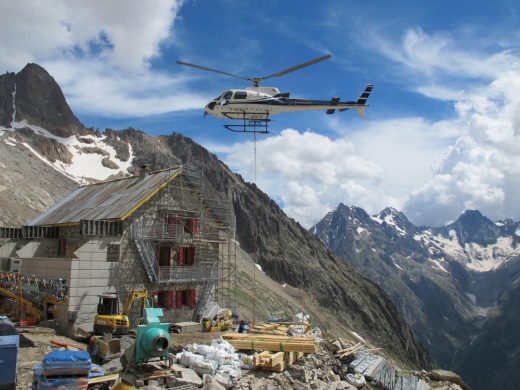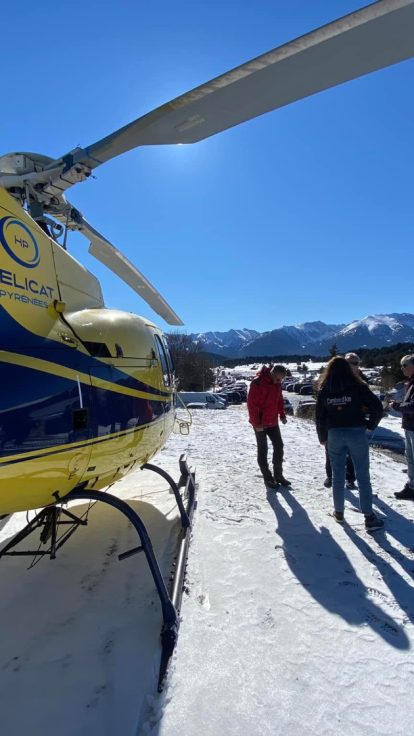
Heli-lift operations make it possible to transport and set down loads where ground-based means cannot operate. From our three bases, Helicat Pyrénées supports professionals and local authorities on worksites in the mountains and in urban environments, with the support of partners throughout France.
We assess access, prepare the operation, and coordinate the necessary procedures. You have a single point of contact, from the site survey to the final lift cycle. Describe your worksite: we will reply within 48 hours.
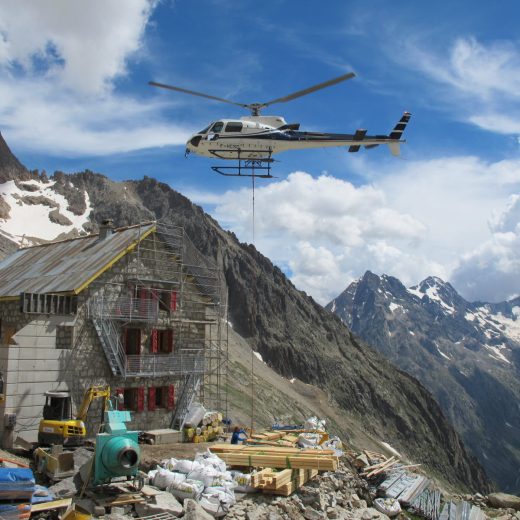
When the crane cannot get through, the helicopter takes over
A helicopter lift depends on a few simple parameters: weight, the number of lift cycles, and the distance between the loading area and the drop-off point. Where a crane requires a platform, access roads, and sometimes several days of assembly, the helicopter works from the air and leaves the ground intact.
This is what makes it relevant on protected sites, in the mountains, on rock faces, or in the middle of an area already occupied by the worksite. You avoid creating an access track and tying up ground footprint.
What load can you have lifted?
The weight determines everything: it dictates the aircraft, the number of lift cycles, and ground organization. If you do not know the exact mass of what you need to lift, send the dimensions and the material; the estimate is made from that.
We cover a range from 0 to 4,500 kg as a sling load. Up to 1,200 kg, the AS350 Écureuil in its B3+ version handles standard worksite loads: concrete, big bags, beams, I-beams, pipes, construction equipment, photovoltaic modules, drilling equipment for cliff work.
Above 1,200 kg, and up to 4,500 kg, your load is carried by the H225. It handles large components: hydraulic turbines, wind turbine masts, structural elements for mountain refuges, bridges, and dikes.
Helicopter lifting up to 4,500 kg, including in urban areas
Two aircraft cover the full load range. Weight, the altitude of the drop-off point, and how constrained the work area is determine the aircraft.
AS350, from 0 to 1,200 kg
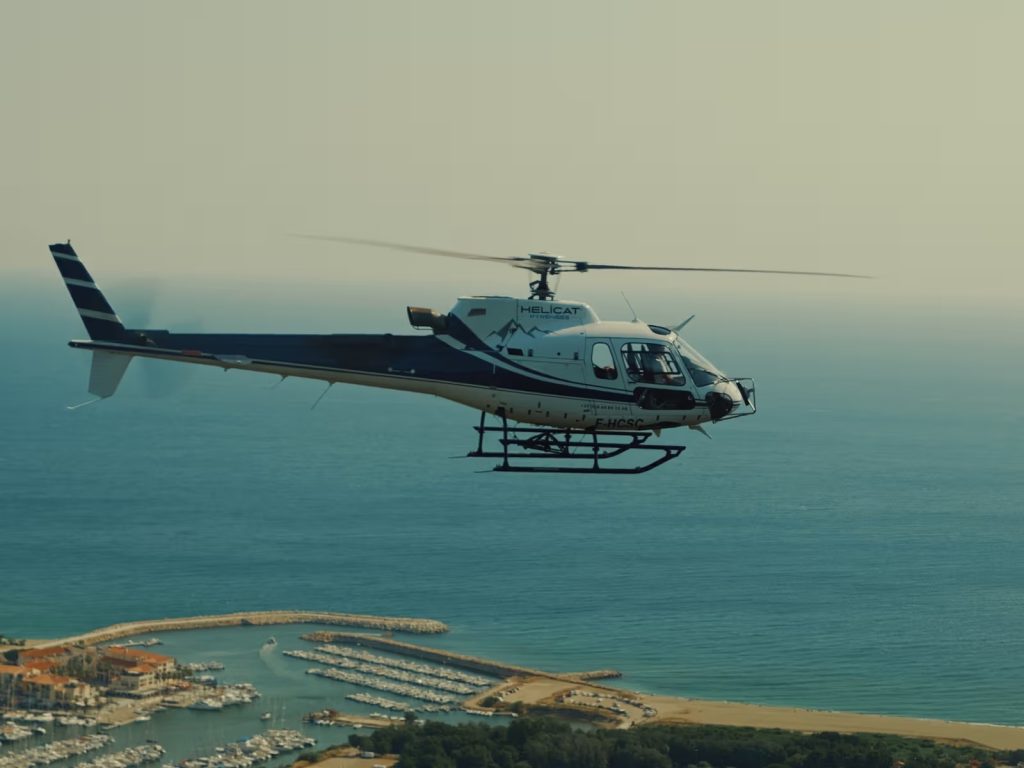
The AS350 is our primary aircraft. It is perfectly suited to standard lifting operations, especially on hard-to-access worksites or in urban environments. Its maneuverability allows for precise operations, even when ground space is limited.
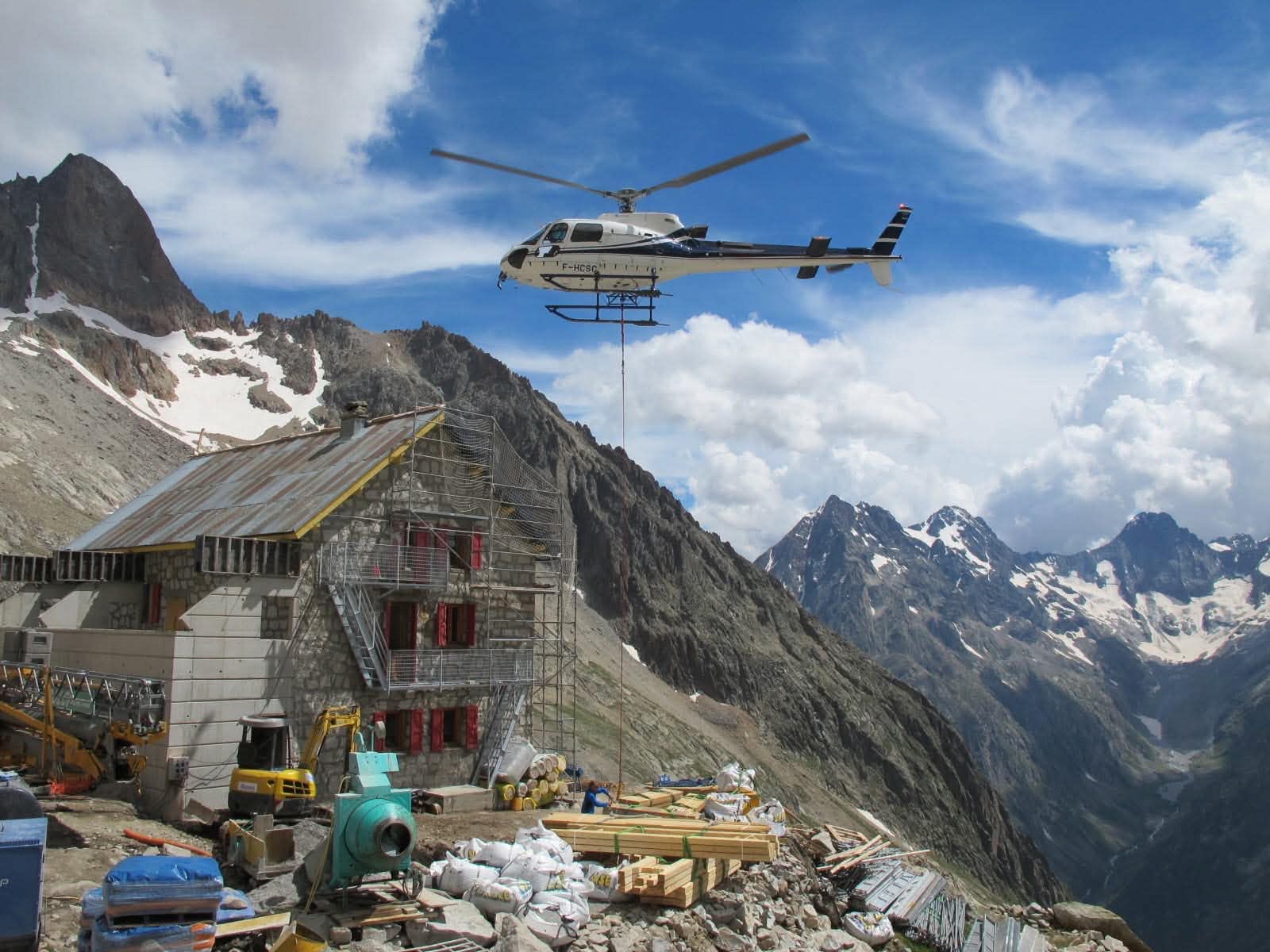
H225, from 1,200 to 4,500 kg
Above 1,200 kg, the H225 takes over and carries loads up to 4,500 kg. Its lifting capacity makes it particularly suitable for heavy and complex operations, including in urban areas and city centers.
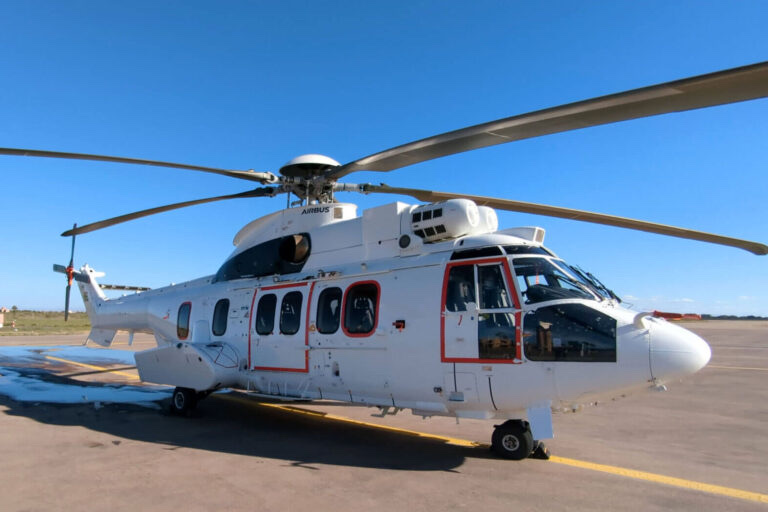
Heli-lift operations in urban areas: permits and preparation
In cities, limited space can complicate crane installation or access to the worksite. Heli-lift operations make it possible to transport and set down loads while keeping road occupation to a minimum.
Each operation begins with a site survey. We define the pick-up and drop-off zones, the safety perimeter, ground resources, and the most suitable time slot. Helicat Pyrénées prepares the files and carries out the authorization procedures with the Prefecture and the DGAC, in coordination with the municipality when the operation requires it.
On the day of the worksite, the crew and the ground team work in continuous radio contact. The operation remains subject to weather conditions: if they do not allow safe operations, we will agree on a new date with you.
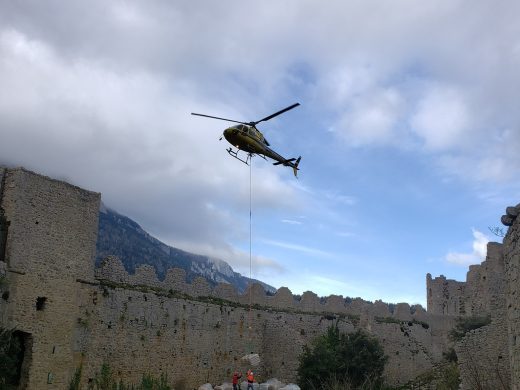
Monitoring, firefighting support, and LiDAR surveying
Heli-lift operations are not Helicat’s only mission. Aerial monitoring is used to inspect structures that are difficult to observe from the ground: power lines, dams, engineering structures, forested areas.
Firefighting support uses the water-bomber helicopter, or HBE, to provide aerial support on wildfires. LiDAR mapping produces a three-dimensional survey by laser scanning, used to model terrain, forest canopy, or linear networks. See also aerial monitoring, firefighting support and LiDAR surveying.
Three worksites, three hard-to-access locations
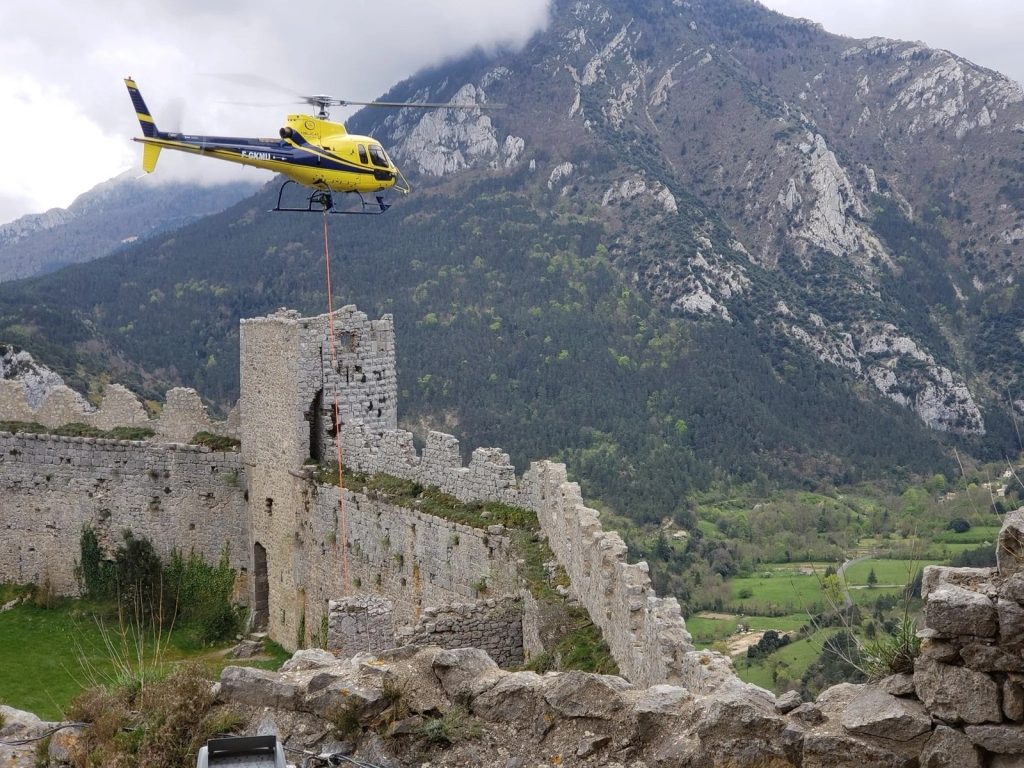
At Château de Puilaurens, in Aude, our teams transported big bags, barriers, and excavators for the renovation of a listed structure perched on a rocky spur and difficult to access by road.

At Lac des Bouillouses, in Pyrénées-Orientales, several lift cycles transported the materials needed to refurbish the hiking footbridges, on a high-altitude site in a protected area.
At Vinça Dam, also in Pyrénées-Orientales, a hydraulic pump was extracted and then transferred by heli-lift to a point defined by the structure’s technicians. Details of these operations are available in our projects.
Where We Operate
Based in southern France, in Pyrénées-Orientales and Haute-Garonne, we operate throughout France thanks to our partner network. Our operations depart from three bases: Perpignan–Rivesaltes Airport, the La Llagonne altiport, and the Marignac / Luchon Valley base. Two of them are mountain bases.
Around them is a first circle where proximity truly makes a difference: Pyrénées-Orientales, Aude, Ariège, Hautes-Pyrénées, and Haute-Garonne. In these departments, positioning transit time is short, making it possible to seize a weather window of a few hours. See heli-lift operations in Perpignan, heli-lift operations in Pyrénées-Orientales, heli-lift operations in Aude, heli-lift operations in Ariège, heli-lift operations in Hautes-Pyrénées, heli-lift operations in Haute-Garonne, heli-lift operations in Foix and heli-lift operations in Bagnères-de-Luchon.
Beyond that, in Hérault, Gard, Tarn, Aveyron, and the regional metropolitan areas, we do not claim proximity as an argument. What we provide is capability: the aircraft sized for the load, the authorization file handled end to end, and an experienced ground team. See heli-lift operations in Toulouse, heli-lift operations in Montpellier, heli-lift operations in Narbonne, heli-lift operations in Hérault, heli-lift operations in Gard, heli-lift operations in Tarn and heli-lift operations in Aveyron.
For the rest of the territory, your project is entrusted to the best-placed partner, with the aircraft adapted to its typology. In both cases, you retain the same contact person, from the first exchange to reception.
Our flights are operated under specialized operating certificate FR.DEC.0204, which covers aerial work.
Frequently asked questions about heli-lift operations
What information should you send us?
The weight and dimensions of each load, the number of items, the municipality and the precise location of the drop-off point, and the desired timeframe. If a loading area has already been identified, please indicate it. These elements are sufficient to frame our response, which you will receive within 48 hours.
What types of loads can be carried as sling loads?
Concrete, big bags, pylons, rockfall barriers, protective nets, pool components, beams and I-beams, drilling equipment, photovoltaic modules, prefabricated modules, relay antennas. The constraint is weight and windage, not the nature of the material.
Is heli-lift possible in a protected area or a listed site?
Yes, and it is often the only practical option. The operations at Lac des Bouillouses and Château de Puilaurens took place in this context. Site-specific authorizations are added to the usual file and are handled upstream of the worksite.
What happens if the weather prevents the flight?
The time slot is confirmed the day before, based on the forecast. A weather-related cancellation is possible up to 24 hours in advance, with rescheduling at no extra cost. A heli-lift flight depends on wind and visibility, and no deadline justifies pushing it.