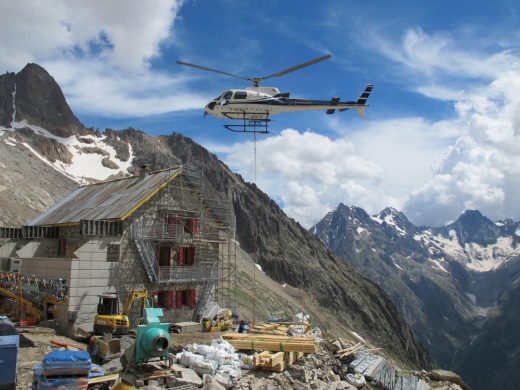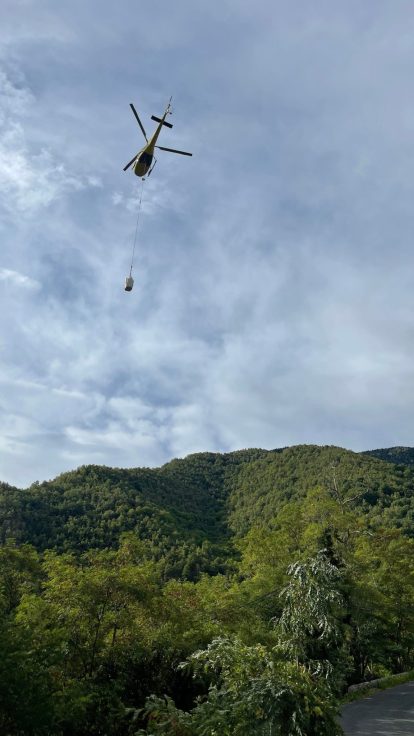
Helicopter lifting makes it possible to deliver an underslung load to a point that neither a truck nor machinery can reach. Around Foix, this concerns summer pastures, the rock faces of the Ariège Valley, mountain huts and mountain structures. Helicat Pyrénées works on these sites for professionals and local authorities.
In Ariège, the issue is almost never weight. It is access and seasonality. A forest track that stops halfway up the slope, a pass closed half the year, a summer pasture two hours’ walk away: the site waits, and the operating window closes in October.
A narrow valley, worksites that cannot be set up down below
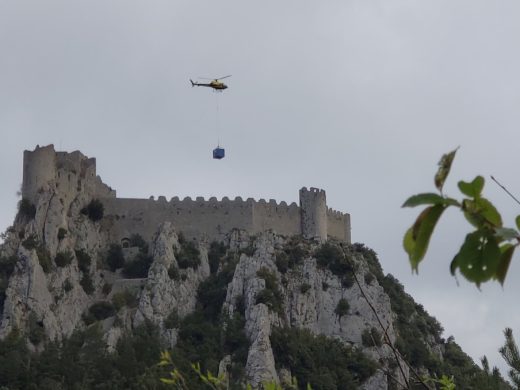
Foix lies at the confluence of the Ariège and the Arget, at the foot of a rocky outcrop crowned by the Counts’ Castle. The town is a bottleneck: the valley narrows here before opening onto the plain to the north and rising toward Upper Ariège and Andorra to the south.
This geography determines everything. The worksites are not in the town; they are above it. On wooded slopes, on ridgelines, in the side valleys of Vicdessos, Couserans or Aston, where the road ends well before the work area.
The RN20, which runs up toward Ax-les-Thermes and the border, is lined with unstable rock faces. Stabilisation works—nets, anchors, rockfall barriers—are carried out on faces where you cannot bring in a crane. The equipment arrives from above, or it does not arrive at all.
1
Which worksites go by air in Ariège
The types of projects encountered here recur from one valley to the next: resupplying summer pasture huts and mountain refuges at the start and end of the grazing season; ski-lift and mountain power-line pylons; drilling and anchoring equipment for rock-face works; and materials for repairing trails, footbridges and structures in the Pyrénées Ariégeoises Regional Natural Park.
Added to this are high-altitude hydroelectric sites and the roofs of isolated buildings, where one helicopter rotation replaces a week of manual carrying.
2
Are special permits required in the mountains?
Yes, and they are in addition to the usual file. An aerial work flight already requires procedures with the DGAC and the prefecture. In mountain areas, site-specific constraints are added: protected area, reserve, perimeter around a listed monument, wildlife sensitivity period.
The file is prepared for you. You do not need to provide any of these documents, but it must be anticipated: these permits are not obtained the day before, and the useful season at altitude is short.
3
Weather decides—and it decides fast
In a Pyrenean valley, the wind shifts from one slope to the other and visibility can change within an hour. The time slot is confirmed the day before based on the forecast, and the operation is postponed at no cost if conditions do not allow safe flying.
This is also why reconnaissance matters so much. A landing zone chosen on a map is worthless: it is selected on site, taking into account the terrain, lines, the prevailing wind direction and a fallback point.
From La Llagonne, Upper Ariège is within reach
Our bases are Perpignan–Rivesaltes Airport, the La Llagonne altiport in Cerdagne, and our Luchon Valley base in Marignac. The latter two are mountain bases, located on either side of Ariège, and active year-round.
This position changes two things for your site: mobilisation time and the ability to seize a short weather window without transiting via the plain. For Couserans, Marignac is the closest point. For Upper Ariège, it is La Llagonne.
Our flights are operated under specialised operations certificate FR.DEC.0204, which covers aerial work.
See also helicopter lifting in Ariège, helicopter lifting in Bagnères-de-Luchon, helicopter lifting in Pyrénées-Orientales and our helicopter lifting page.
Frequently asked questions about helicopter lifting in Foix
Up to what altitude can you deliver a load?
Altitude and temperature reduce a helicopter’s payload; this is a physical constraint, not a commercial one. The higher the drop-off point and the warmer the air, the less the aircraft can carry. This is why the exact weight and the altitude of the landing point are the first two pieces of information requested for a quote.
Can helicopter lifting be carried out during the summer pasture season, with herds in the area?
Yes, but it requires preparation. Low-level overflight and rotor noise disturb animals. The flight is coordinated with the shepherd or pastoral association, and the route avoids pens and watering points. This must be reported as early as the reconnaissance visit.
What is the best period for a high-altitude worksite in Ariège?
The useful window runs from snowmelt to autumn, and it varies depending on slope exposure. A site scheduled in June almost always goes ahead; the same site decided in October depends on the first snowfall. The decision date matters as much as the flight date.
Does the Château de Foix impose overflight constraints?
The surroundings of a protected monument and the urban centre are subject to specific overflight rules, which are checked case by case depending on the route and altitude. This is addressed when the file is prepared, upstream.
What information is required to obtain a quote?
The weight and dimensions of each load, the number of items, the altitude and precise location of the drop-off point, a truck-accessible loading area if you have identified one, and the deadline. You will receive our reply within 48 hours.