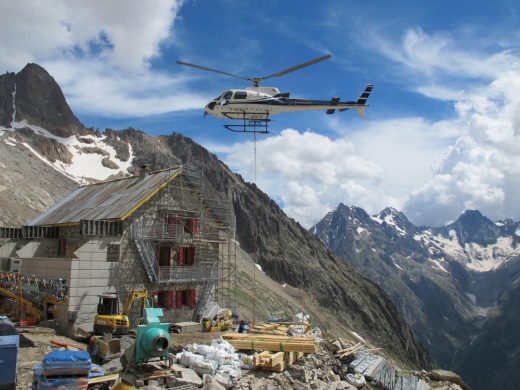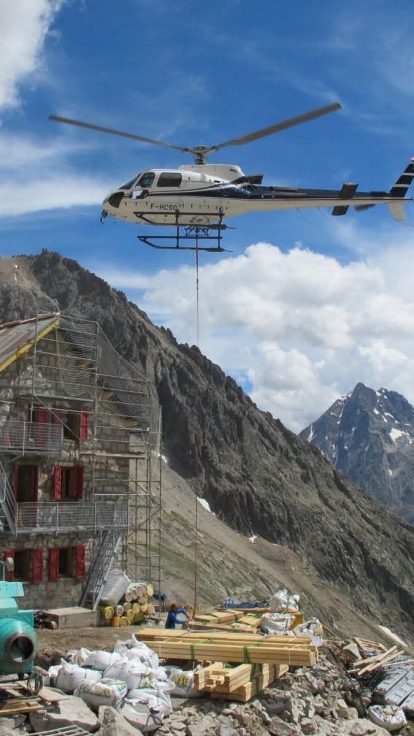
Helicopter transport delivers a sling load to a point unreachable by any other vehicle. In the Hautes-Pyrénées, the difficulty comes not from the total distance but from the department’s shape. Helicat Pyrénées operates on these sites for professionals and communities.
Here, you don’t travel from one valley to another. You descend to the plain, then ascend again. A nearby site on the map can be two hours away by road.
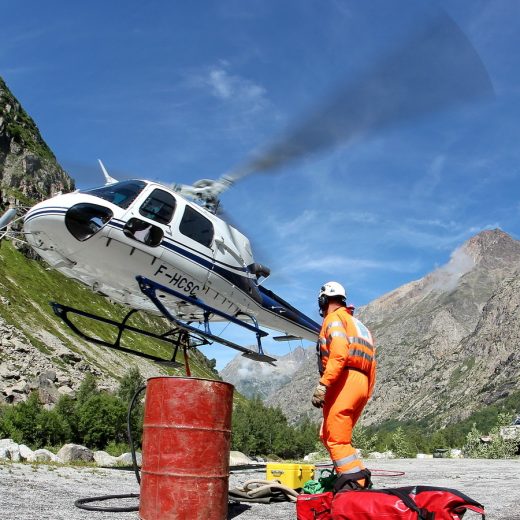
A Fan of Closed Valleys
From the Adour plain, several valleys fan out towards the border, each ending in a natural barrier beyond which the road stops.
The Aure and Louron valleys to the east, separated from the rest of the department by high-altitude passes. The Pays Toy and Gavarnie valley in the center, with its UNESCO World Heritage cirque. The Cauterets valley to the west. And between the two, the Néouvielle massif and its lakes, as well as the Pic du Midi de Bigorre and its observatory at the end of the Tourmalet road.
For a project, this geography imposes a simple rule: the loading zone must be located in the project’s valley, not elsewhere. Each kilometer of transit flight is counted in minutes, and the road journey for a supply truck from one valley to another takes half a day.
Marignac, at the Mouth of the Louron Valley
Our operations depart from Perpignan-Rivesaltes airport, La Llagonne altiport, and the Luchon valley base in Marignac. The latter is located immediately east of the department, adjacent to the Louron valley.
For a project in Aure or Louron, this is the shortest starting point. For the western valleys, Cauterets and Gavarnie, setup takes longer and is prepared accordingly.
For the rest of the territory, your project is entrusted to the best-placed partner, with the aircraft adapted to its typology. In both cases, you retain the same contact person, from the first exchange to reception.
Three Sectors Generating Most Projects
High-mountain hydroelectricity concentrates the heaviest operations: high-altitude dams, water intakes, penstocks, on sites without usable road access and often in operation.
Ski resorts follow, dense in this department: pylons, stations, cables, with projects scheduled off-season or during very specific windows when the resort is operating.
Finally, mountain equipment: refuges, footbridges, trails, pastoral huts, and structures of the Pyrénées National Park, whose core zone imposes its own regulations on overflights and sensitive periods for wildlife.
The Schedule is Decided Before the Weather
In this department, two calendars overlap. That of snow, which closes high-altitude sites for a good part of the year. And that of authorizations, which takes longer as soon as a project enters the national park’s perimeter or concerns an operational structure.
The result is counter-intuitive: the decision date often matters more than the flight date. A project initiated in spring takes place within the season. The same project decided in September waits until the following year.
The slot is confirmed the day before based on forecasts, with no-cost postponement if conditions do not allow for safe flight.
Our flights are operated under specialized operating certificate FR.DEC.0204, which covers aerial work.
See also helicopter transport in Bagnères-de-Luchon, helicopter transport in Haute-Garonne, helicopter transport in Ariège and our helicopter transport page.
Frequently Asked Questions about Helicopter Transport in the Hautes-Pyrénées
Can two valleys be served on the same day?
Rarely cost-effectively. Each valley requires its own loading zone, and thus its own truck delivery. Grouping several points within the same valley significantly reduces the unit cost; grouping two valleys hardly reduces it.
Can we operate on an operational dam or water intake?
Yes, this is a common case in this department. The operation is coordinated with the operator: time slot, potential lockout/tagout, safety perimeter, coordination with on-site teams. The main constraint is organizational rather than technical.
Are specific authorizations required in the Pyrénées National Park?
Yes. They are added to the usual file and depend on the zone, period, and nature of the project. This is the first point to address for a project within this perimeter, because it dictates the entire schedule.
How much can be lifted at 2,000 meters?
Less than at sea level. Altitude and temperature reduce lift, and thus the payload. The same aircraft carries more on a May morning than on an August afternoon. The altitude of the drop-off point is requested from the first exchange.
What information should be provided to obtain a quote?
The weight and dimensions of each load, the number of pieces, the valley, the altitude and precise location of the drop-off point, a truck-accessible loading zone if you have identified one, and the deadline. You will receive our response within 48 hours.