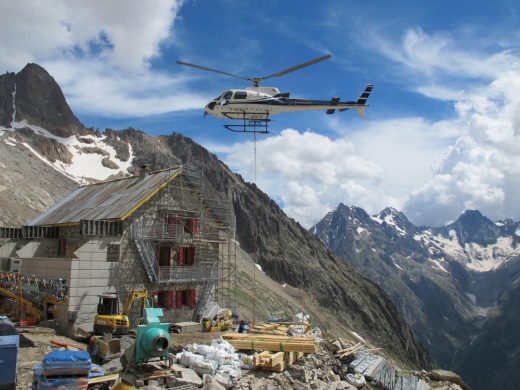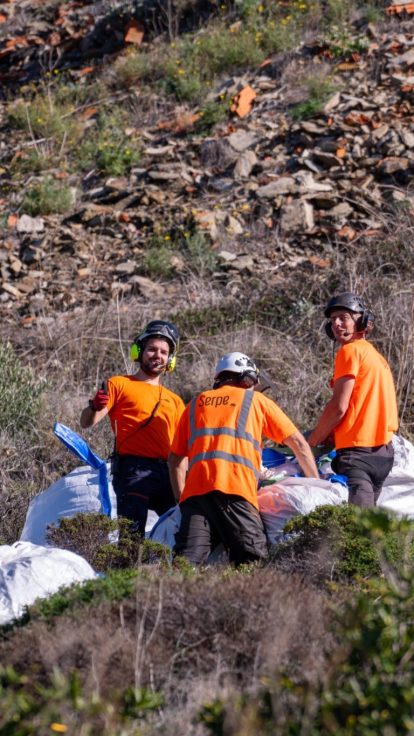
Helicopter lifting places a sling load at a point no ground equipment can reach. In Aude, these points often have a name: a hilltop castle, a wind-farm ridge, a rocky spur above a valley. Helicat Pyrénées has been working on these sites from its Perpignan base, just a few minutes’ flight from the south of the department.
It is also in Aude that we carried out one of our most representative projects.
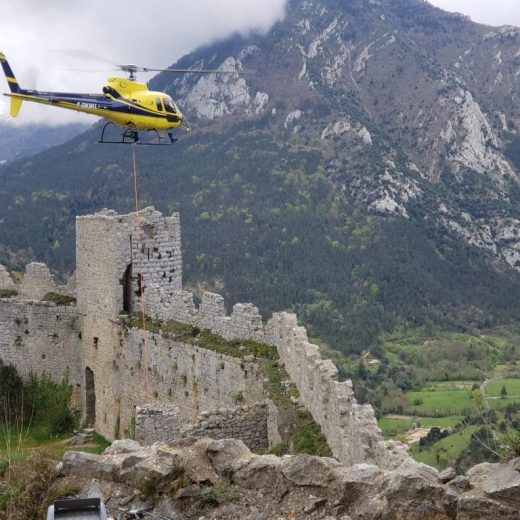
Château de Puilaurens: a listed monument with no vehicle access
Château de Puilaurens stands on a rocky spur above the Boulzane Valley, in the Corbières. No road leads up to it.
For its renovation, our teams transported the site equipment by helicopter: big bags, safety barriers and excavators. On a structure perched like this, the challenge is not the individual load weight, but the repeated rotations and the precision required to set down on a small platform surrounded by open space.
Helicopter lifting also avoided opening a track on a protected slope, which would have left a lasting impact.
A department of ridges and citadels
Aude is organised around a central corridor—the Lauragais and the Aude Valley—between two very different areas.
In the south
The Corbières and the Pays de Sault: dry limestone terrain cut by gorges and crowned with hilltop citadels. This is the area where road access ends the fastest.
In the north
The Montagne Noire, a forested and humid slope, with equipped ridgelines and narrow valleys.
Between the two
The windy corridor linking the Atlantic and the Mediterranean, one of the most exposed in France. It hosts a large number of wind farms, installed precisely on the least accessible ridges.
And to the east
The coastline and the Narbonne lagoons, with sensitive environments where the movement of machinery is regulated.
Which worksites in Aude require air support
Hilltop heritage sites
With restoration works on listed sites where the footprint on the ground is highly constrained. Puilaurens is one example, but it is not the only one.
Wind power
Very common on the department’s ridges: lifting and transporting equipment to sites where the access track cannot support a convoy, or crosses an area you do not want to widen.
Ridge networks and relay sites
Stabilisation works on cliff faces in the gorges, and hiking infrastructure in the Pays de Sault and the Corbières.
On the coast and around the lagoons: hydraulic structures, dikes and developments in sensitive environments, where the helicopter avoids the passage of machinery.
Wind, the department’s main constraint
The Aude corridor is swept by the tramontane and the marin, two opposing wind regimes that alternate quickly. This explains the density of wind farms, and it is also what most constrains operations.
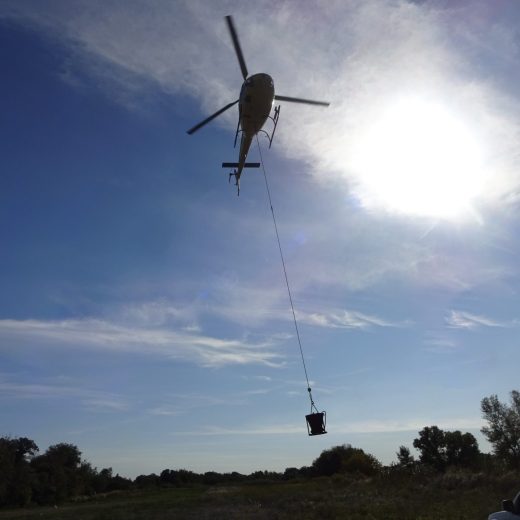
With a sling load, sustained wind makes the load unstable and makes precise placement difficult. On a cliff-face site or on a ridge, the limit is reached sooner than elsewhere.
The time slot is therefore confirmed the day before, based on the forecast, with rescheduling at no charge if conditions do not allow safe flying. In this department more than others, this buffer should be built into the schedule rather than endured.
A base in the immediate vicinity
Our operations depart from Perpignan–Rivesaltes Airport, the La Llagonne altiport, and our Luchon Valley base in Marignac.
Perpignan is directly adjacent to the south of Aude. For the Corbières, the Pays de Sault and the Narbonne coastline, it is the shortest departure point outside the department. This reduced transit makes it possible to take advantage of a wind window that opens for a few hours.
Our flights are operated under the specialised operations certificate FR.DEC.0204, which covers aerial work.
See also helicopter lifting in Narbonne, helicopter lifting in Pyrénées-Orientales, our projects and our helicopter lifting page.
Frequently asked questions about helicopter lifting in Aude
Can you work on a hilltop castle or a listed monument?
Yes, the Château de Puilaurens project was exactly this case. Operations and overflight are subject to site-specific rules and its protected perimeter, covering the route and altitude. This is the first point checked in advance.
Do you work on the wind farms in the Corbières?
Helicopter lifting is used to lift and transport equipment on this type of site, particularly when the track cannot support a convoy. The weight and dimensions of the parts determine the aircraft. On a windy ridge, the flight window is the limiting factor.
Does the tramontane prevent work?
Not systematically, but it sets a lower limit than elsewhere. With a sling load, wind that is too strong makes the load unstable and the operation is rescheduled at no charge. This is why the time slot is confirmed the day before, not several weeks in advance.
Can a load be set down at the bottom of a gorge?
Yes, and it is often the only practical method in the Corbières. The loading area is set up on the plateau, as close as possible to the drop point. Wind channelled by the cliff walls and the approach path are checked on site; a map is not enough.
What information is required to obtain a quote?
The weight and dimensions of each load, the number of items, the municipality and the precise location of the drop point, a loading area accessible by truck if you have identified one, and the deadline. You will receive our response within 48 hours.