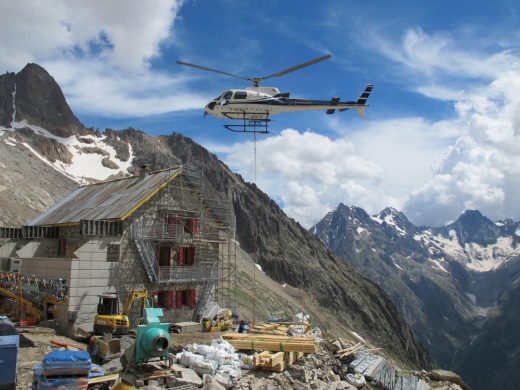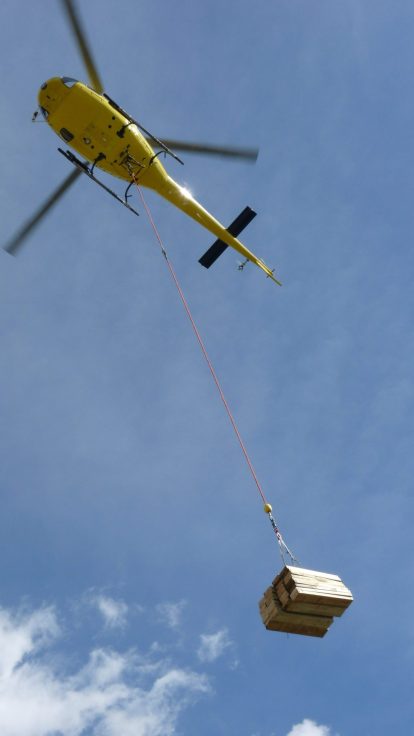
Helicopter transport involves depositing an underslung load by helicopter at points that are difficult to access for traditional lifting equipment. In Montpellier, the challenge is almost always the same: reaching the drop-off point. Helicat Pyrénées operates on these sites for professionals and local authorities.
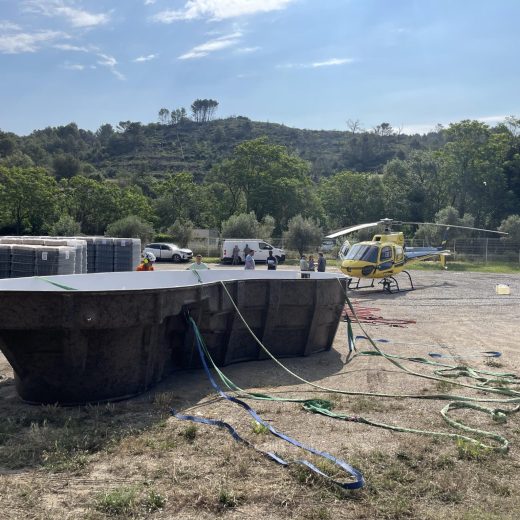
The Écusson: a center where trucks cannot enter
The historic heart of Montpellier, the Écusson, is a network of medieval streets that are largely pedestrianized, featuring adjoining buildings, enclosed inner courtyards, and protected private mansions.
In this urban fabric, the issue is not lifting power but access. A mobile crane cannot enter most of these streets, and even when it can, there is nowhere to deploy its outriggers. Furthermore, protection perimeters regulate intervention and overflight, which must be addressed during the initial file preparation.
The helicopter operates vertically and clears the space in a few rotations, whereas a ground installation would immobilize a street for several days.
Three other terrains around the Écusson
Recent neighborhoods and business zones, with their office buildings, rooftop technical equipment, and logistics sites.
Health and research facilities, which are numerous in the metropolitan area, where rooftop interventions are carried out on buildings in continuous operation and require strict coordination.
And the nearby garrigue to the north, which begins just a few kilometers from the center. Pylons, relays, reservoirs, and protection structures are difficult to transport there via narrow tracks, often reserved for fire defense.
Requirements for operations in dense urban areas
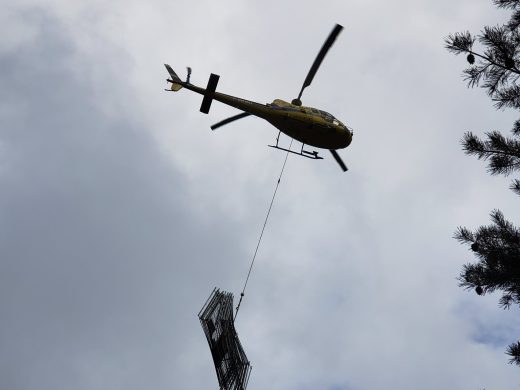
A helicopter transport operation in Montpellier requires more extensive preparation than an isolated site.
It requires a ground safety perimeter, coordination with the municipality or site manager, sometimes temporary road closures, and a time slot chosen outside of peak hours. In a pedestrian sector, the question of the perimeter is different: there is no traffic to interrupt, but there are crowds to manage.
The loading zone is located away from the center on flat ground, accessible by truck and clear of power lines. Its selection determines the number and duration of the rotations.
The operation then unfolds in four stages: on-site scouting, DGAC, prefecture, and resident authorizations handled for you, slinging with a ground crew and radio coordination, and finally a weather window confirmed the day before, with a free postponement if conditions do not allow for safe flight.
Capability over proximity
Our bases are in the Pyrenees, at Perpignan-Rivesaltes, La Llagonne, and Marignac / Luchon valley. Montpellier is not on our doorstep, and we prefer to be transparent about that.
What we provide here is capability: the appropriate aircraft for the load, complete file management in dense urban zones, a ground crew experienced in slinging within constrained environments, and a single point of contact from the first exchange to the final rotation. Depending on the type of project, we mobilize the best-positioned partner.
Our flights are operated under the specialized operating certificate FR.DEC.0204, which covers aerial work.
See also helicopter transport in Hérault, helicopter transport in Narbonne and our helicopter transport page.
Frequently asked questions about helicopter transport in Montpellier
Is it possible to fly over the Écusson for helicopter transport?
Low-altitude overflight above a dense and protected center is subject to specific rules regarding trajectory and height. This is the first point verified for any city-center project during the preliminary stages.
How is it handled in a pedestrian street?
The absence of traffic simplifies one aspect while complicating another. There are no roads to close, but there is foot traffic to manage. The time slot is chosen for early morning, with a safety perimeter maintained on the ground during rotations.
Can you operate on a building in continuous operation?
Yes, with strict coordination with the site manager: time slots, perimeter, and notification of occupants. This type of operation is prepared several weeks in advance and generally takes place in the early morning.
Do you operate in the garrigue north of the city?
Yes. This is a case where the helicopter avoids the need to widen or create a track for a one-off project. During periods of high fire risk, access to these areas may be restricted, which is verified when scheduling the operation.
What information is needed to obtain a quote?
The weight and dimensions of each load, the number of items, the address and precise location of the drop-off point, any known access constraints, and the deadline. You will receive our response within 48 hours.