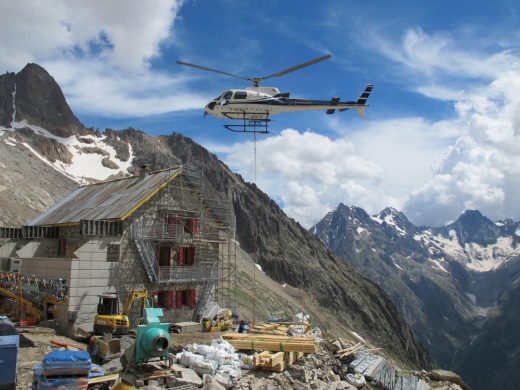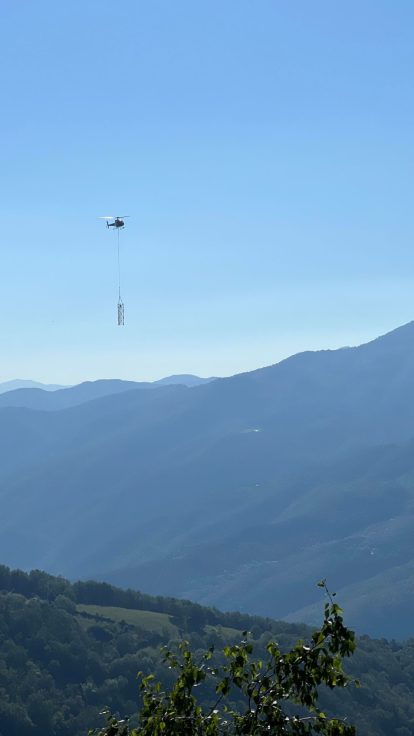
Helicopter transport delivers a sling load where lifting equipment can neither access nor be installed. Around Narbonne, three situations frequently occur: the massif without tracks, lagoon environments where machinery cannot be driven, and a dense historic center where space is unavailable. Helicat Pyrénées operates from its base in Perpignan, approximately sixty kilometers away.
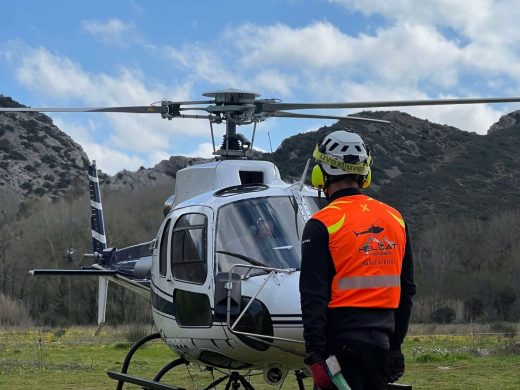
La Clape, a massif by the sea
The La Clape massif separates Narbonne from the coastline. It is a dry limestone plateau, covered in scrubland, carved with gorges, and crossed by narrow tracks often reserved for fire defense.
On this terrain, pylons, relays, reservoirs, and protective structures are difficult to transport by road. Widening a track for a one-off project causes lasting damage to a fragile environment.
The massif is also exposed to the risk of wildfires, which can restrict access in summer and delay a project. This is a scheduling factor just like the weather.
The lagoons, a terrain where driving is prohibited
To the south and east
The Narbonne lagoon complex—Bages-Sigean, Gruissan, La Palme—forms a chain of ponds and protected wetlands.
Hydraulic structures
Dikes, sills, footbridges, and management equipment are numerous there, and the movement of machinery is strictly regulated when not prohibited. Furthermore, the ground has low bearing capacity, which often precludes the installation of a crane on outriggers.
The helicopter operates vertically
Without a lasting footprint on the ground. This is frequently the only method compatible with the status of these zones.
The canal, the city, and the wind
The Robine Canal runs through the center of Narbonne, with its quays, bridges, and engineering structures. Surrounding it is a dense medieval center, dominated by the Saint-Just Cathedral, where narrow streets and protection perimeters regulate all high-altitude interventions.
Finally, Narbonne is one of the windiest cities on the coast, exposed to both the Tramontane and the Marin winds. With a sling load, sustained wind makes the cargo unstable and forces the operation to be postponed. The time slot is confirmed the day before based on forecasts, with a free reschedule if conditions do not allow for safe flight.
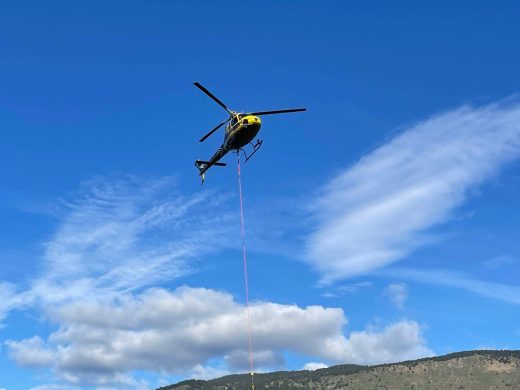
A base sixty kilometers away
Our operations depart from Perpignan-Rivesaltes Airport, La Llagonne Altiport, and the Luchon Valley base in Marignac.
Perpignan is the shortest starting point for the Narbonne area. In a sector where the wind window sometimes opens for only a few hours, this reduced transit time matters as much as the price.
The authorization file is prepared for you: DGAC and prefecture procedures, resident information, coordination with the municipality or site manager. In protected wetlands, specific authorizations are added and handled in advance.
Our flights are operated under the specialized operating certificate FR.DEC.0204, which covers aerial work.
See also helicopter transport in Aude, helicopter transport in the Pyrénées-Orientales and our helicopter transport page.
Frequently asked questions about helicopter transport in Narbonne
Is it possible to operate in a protected wetland?
Yes, and it is often the only viable option since the movement of machinery is regulated there. Overflight and delivery are subject to rules specific to these areas, which depend on the zone and the period, particularly regarding nesting. This is the first point addressed for a project in a lagoon sector.
How to service a point in the La Clape massif?
By direct delivery, which avoids widening or creating a track. A clear drop-off area, a verified approach path, and a fallback point are required. The loading zone is placed as close as possible, on the periphery of the massif. An on-site survey settles these points.
Does the Tramontane prevent work?
Not systematically, but it sets a lower limit than elsewhere. With a sling load, excessive wind makes the cargo unstable and the operation is postponed at no cost. This is why the time slot is confirmed the day before.
Can you operate in the city center, near the canal?
Yes, with a safety perimeter, coordination with the municipality and, if applicable, with the canal manager. The protection perimeters of the old center regulate the trajectory and height, and are verified in advance.
What information is needed to obtain a quote?
The weight and dimensions of each load, the number of items, the precise location of the drop-off point, the status of the site if it is protected, a loading zone if you have identified one, and the deadline. You will receive our response within 48 hours.