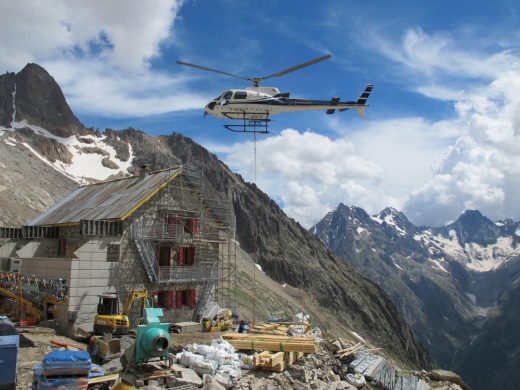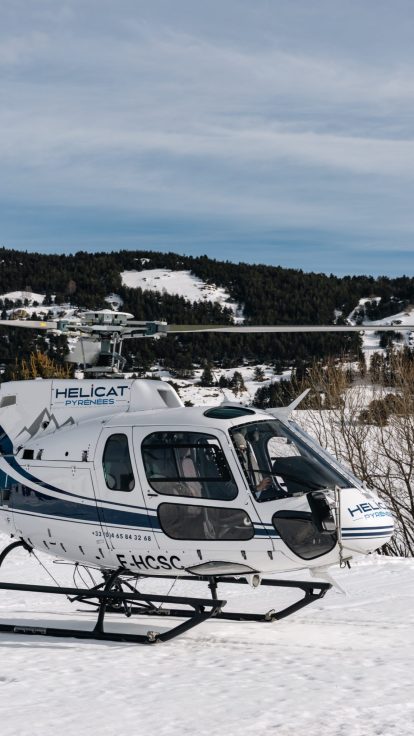
Helicopter lifting places a sling load at a drop-off point that no machine can reach. In Luchon, Helicat Pyrénées operates from its valley base in Marignac, at the entrance to the upper Pique Valley.
On a high-mountain worksite, this location is not a marketing detail. It determines what can be achieved in a day.
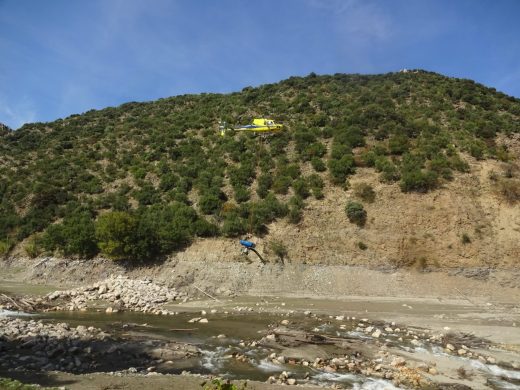
A cirque of closed valleys
Bagnères-de-Luchon lies at the bottom of a valley that closes in to the south at the Spanish border. Around it is a chain of dead-end valleys: the Lys Valley, the Pique Valley, the Astau Valley and Lake Oô, and the Vénasque Pass.
All these valleys share the same structure: a valley road that ends at a barrier, and then nothing but trails. Everything above—hut, cabin, structure—must be supplied by pack carry or by air.
To the east, the Peyresourde Pass opens onto the Louron Valley and the Hautes-Pyrénées. To the west, you cross over toward the Couserans area of Ariège. Luchon is a mountain crossroads, but one crossed via passes, not valleys.
Which worksites here rely on air transport
High-altitude facilities first
Mountain huts, pastoral cabins, footbridges, trails, and protective structures along hiking routes.
Ski lifts
With the Superbagnères and Peyragudes ski areas in the immediate vicinity: towers, stations, cables, maintenance equipment.
Pastoralism
Very present in these valleys: supplying summer pastures at the start and end of the season, watering troughs, fencing.
Ridge networks and relay sites
As well as rock-face stabilization works along valley roads and access routes to the passes.
Finally, there is the spa activity and the historic buildings in the town centre, where narrow streets and the roofs of the spa town create the same footprint constraints as any historic centre.
What proximity really changes
Two concrete things.
First, transit time. From Marignac, the upper valley is only a few minutes’ flight away. Avoiding that transit matters all the more when rotations are numerous.
Second, the weather window—and this is the decisive point. In high mountains, conditions sometimes open up for two or three hours early in the morning. An operator coming from the lowlands cannot take advantage of that slot. From the valley, a job postponed several times can still be completed before the end of the season.
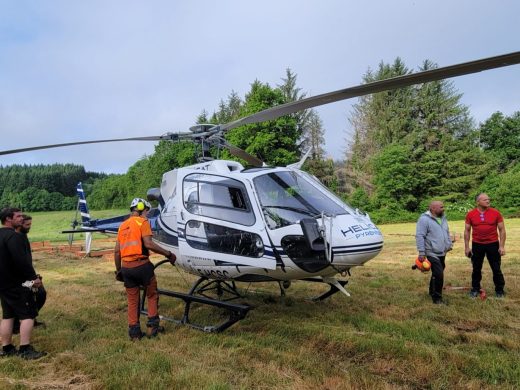
A short season—plan ahead
The workable window at altitude runs from snowmelt to autumn, and it varies from one slope to another. A summer-pasture resupply scheduled in spring goes ahead. The same job decided in October depends on the first snowfall.
In these valleys, the decision date therefore matters as much as the flight date. Permits are not obtained the day before either, especially in protected areas or during sensitive periods for wildlife.
The file is prepared for you: DGAC and prefecture procedures, informing local residents when the overflight area requires it, and coordination with the site operator or manager. You do not need to provide any of these documents.
The slot is confirmed the day before based on the forecast, with rescheduling at no charge if conditions do not allow safe flying.
Our flights are operated under the FR.DEC.0204 specialised operations certificate, which covers aerial work.
See also helicopter lifting in the Hautes-Pyrénées, helicopter lifting in Haute-Garonne, helicopter lifting in Ariège and our helicopter lifting page.
Frequently asked questions about helicopter lifting in Luchon
How much can you lift in high mountains?
Less than in the lowlands. Air becomes thinner with altitude and expands with heat, which reduces lift and therefore payload. The same aircraft can carry more on a May morning than on an August afternoon. The altitude of the drop-off point is requested from the first exchange, just like the weight.
Can you serve several valleys in the same day?
Rarely in a cost-effective way. Each valley requires its own loading area, and therefore its own truck transport. Grouping several points within the same valley significantly reduces the unit cost; crossing a pass reduces it hardly at all.
Can you work on a ski area while it is operating?
Yes, with coordination with the operator and a slot outside piste opening hours, often early in the morning. Most ski-lift works are carried out out of season, but an emergency during winter can still be handled.
Can helicopter lifting be carried out during the summer-pasture season?
Yes, but it requires preparation. Low-level overflight and rotor noise disturb livestock. The flight is scheduled with the shepherd or pastoral group, and the route avoids pens and watering points. Please mention this during the site survey.
What information is required to obtain a quote?
The weight and dimensions of each load, the number of items, the valley, the altitude and precise location of the drop-off point, a truck-accessible loading area if you have identified one, and the deadline. You will receive our response within 48 hours.