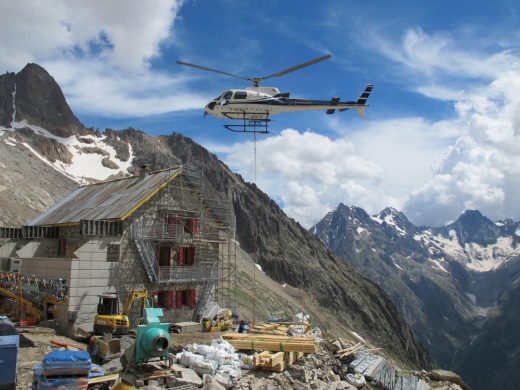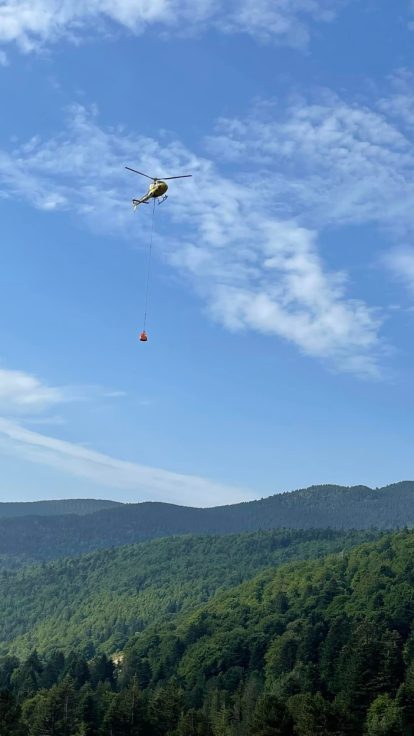
Helicopter lifting deposits a sling load at a point that no ground vehicle can reach. In the Gard, this impediment has three distinct causes depending on the location: the slope, the schedule, or the ground bearing capacity. Helicat Pyrénées intervenes on these sites for professionals and local authorities.
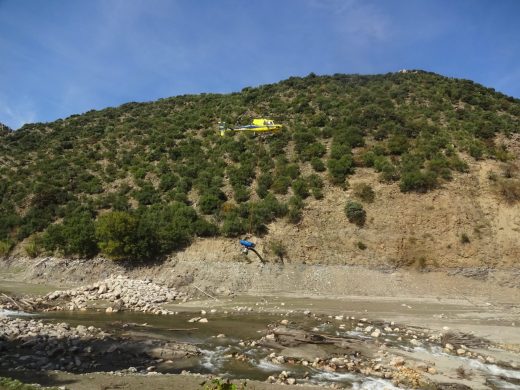
The Cévennes: The Slope
To the north and west, the Cévennes massif encloses the department. Narrow valleys, schistous slopes covered with chestnut groves, and a road that consistently follows the valley floor.
Everything located halfway up the slope or on the ridge is out of reach: perched hamlets, isolated farmhouses, networks, and protective structures. Existing tracks quickly degrade on this type of slope, and widening them for a one-off project leaves a lasting mark on the environment.
Part of the massif falls within the Cévennes National Park, with its own regulations on overflights and sensitive periods for wildlife. A project within this perimeter requires additional authorizations, which must be anticipated several weeks in advance.
1
The Garrigue: The Schedule
In the center, between Nîmes, Alès, and Uzès, the limestone plateaus covered with low garrigue are crisscrossed by narrow tracks, often reserved for fire defense.
Here, the main constraint is not access but the period. These massifs are among the most exposed to forest fires, and during periods of high risk, access is regulated, with certain works suspended. The useful season narrows to spring and autumn.
The prefectural decree in force is therefore one of the points to check when scheduling the operation, just like the weather.
2
The Gard Camargue: The Bearing Capacity
To the south, the coastal plain and wetlands of the Gard Camargue pose an inverse problem. The terrain is flat and often accessible, but it lacks bearing capacity.
A crane on outriggers cannot be set up on a dike or a waterlogged embankment, and the movement of machinery in protected wetland areas is regulated, if not prohibited. Hydraulic structures, dikes, weirs, and marsh management equipment must be handled by air or not at all.
The period also matters: high water levels limit access to the surroundings and render certain loading zones unusable.
3
The Cévennes Episode, Common to All Three
The Gard is the typical department for intense autumn rains. They cannot be bypassed; they close the window of opportunity.
The flight is therefore confirmed the day before based on forecasts, with no-cost postponement if conditions do not allow for safe flying. On a Cévennes site, flooding can also render access impassable for several days after the episode.
Capacity Rather Than Proximity
Our bases are in the Pyrenees, in Perpignan-Rivesaltes, La Llagonne, and Marignac / Luchon Valley. The Gard is not on our doorstep, and we prefer to state that upfront.
What we offer here is capacity: the equipment adapted to the load, the AS350 Écureuil from 0 to 1,200 kg and the H225 up to 4,500 kg, the complete assembly of the authorization file, an experienced ground team, and a single point of contact from the first exchange to the last rotation. Depending on the type of project, we mobilize the best-placed partner.
Our flights are operated under specialized operating certificate FR.DEC.0204, which covers aerial work.
See also helicopter lifting in Hérault, helicopter lifting in Aveyron and our helicopter lifting page.
Frequently Asked Questions about Helicopter Lifting in the Gard
Can work be done in the Cévennes or garrigue in summer?
It depends on the prevailing fire risk level. During red periods, access to the massifs is restricted and certain works are suspended. This is a regulatory constraint, not a commercial one. Spring and autumn offer safer windows.
How to deposit a load halfway up a wooded slope?
A sufficient clearing is needed for the load’s descent and a clear fallback point. In a dense chestnut grove, this sometimes requires clearing a small area upstream. On-site reconnaissance determines this point.
Are specific authorizations required in the Cévennes National Park?
Yes, these are added to the usual file and depend on the zone, period, and nature of the project. This is the first point to address for a project in this perimeter, as it dictates the entire schedule.
Can we intervene on a dike or in a wetland area?
Yes, and it is often the only compatible method. The ground lacks bearing capacity, and the movement of machinery is regulated. The difficulty shifts to choosing a flat, load-bearing loading zone outside the flood-prone area.
What information should be provided to obtain a quote?
The weight and dimensions of each load, the number of pieces, the municipality and precise location of the drop-off point, the status of the site if it is protected, a loading zone if you have identified one, and the deadline. You will receive our response within 48 hours.