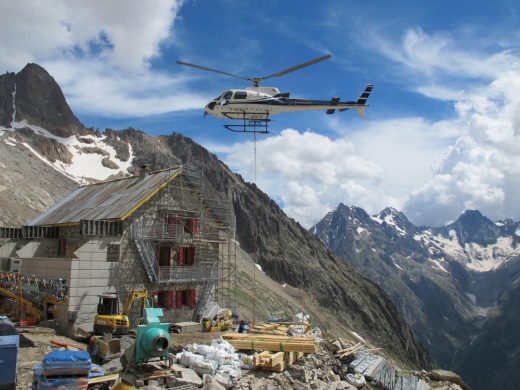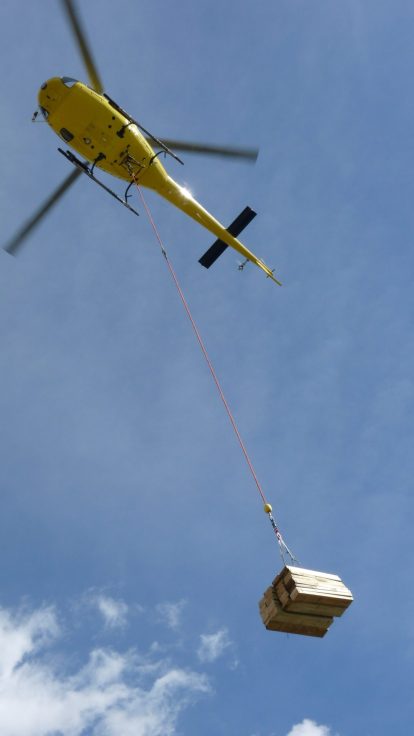
Helicopter lifting places a sling load where no machinery can reach. Aveyron is one of France’s largest departments, and it has not one geography but four. Helicat Pyrénées operates on these worksites for professionals and local authorities.
A worksite on the Larzac and a worksite on the Aubrac do not have the same access, the same season, or the same constraints. Treating them the same way is the first mistake.
The causse, the plateau, the Ségala and the gorges
In the south
The Grands Causses, with the Larzac foremost, form arid limestone plateaus—vast, sparsely populated, and crossed by few roads. The soil is thin and the subsoil is karstic, which limits the use of heavy machinery and the opening of access tracks.
In the north-east
The Aubrac is a high-altitude basalt plateau, snow-covered for several months a year, shaped by pastoralism and its stone huts. The workable season is short, and it ends early.
In the west
The Ségala is a land of shale hills cut by wooded valleys, with scattered housing and wind farms along the ridgelines.
And everywhere
The gorges: those of the Tarn and the Jonte in the south, and those of the Lot and the Truyère in the north. The Truyère in particular concentrates a major hydroelectric complex, with structures installed in steep, wooded valleys.
What geography changes for your worksite
On the causse
The key issue is ground bearing capacity. A machinery platform cannot be installed everywhere, and a track opened for a one-off worksite leaves a lasting mark on a dry environment. The helicopter eliminates the ground issue.
On the Aubrac
The key issue is the time window. A stone-hut project, summer-pasture fencing or a watering point must fit between the thaw and the first snowfalls, with little margin.
In the Ségala
The key issue is access to the ridgelines: pylons, relay antennas, wind turbines—via tracks that cannot withstand a heavy convoy.
In the gorges
The key issue is verticality. The loading zone is set up on the plateau, as close as possible to the drop-off point, and the aircraft descends. It is shorter, safer and less damaging than widening a track. On an operating hydroelectric facility, the operation is also scheduled with the operator.
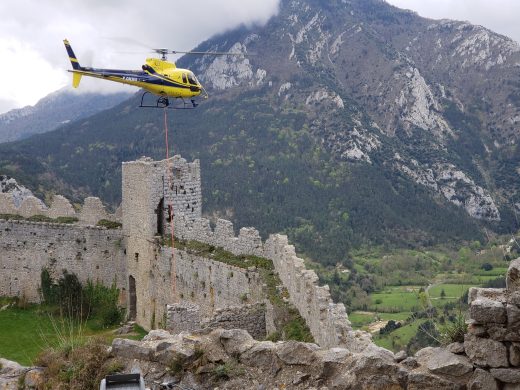
A rich heritage, often perched
Aveyron has a large number of protected buildings and villages built on spurs or steep slopes, with lanes too narrow for lifting equipment.
On this built heritage, the helicopter often offers a decisive advantage: it requires no ground footprint—no platform and no temporary access road. Protection perimeters govern the work and overflight, and this is handled when the application file is prepared, upstream.
Capability rather than proximity
Our bases are in the Pyrenees, at Perpignan–Rivesaltes, La Llagonne and Marignac / the Luchon valley. Aveyron is not on our doorstep, and we prefer to say so.
What we bring here is capability: the aircraft suited to the load, full preparation of the authorisation file, an experienced ground team, and a single point of contact from the first exchange to the final rotation. Depending on the type of worksite, we mobilise the best-placed partner.
The file is prepared for you: DGAC and prefecture procedures, informing local residents, coordination with the operator or site manager. The slot is confirmed the day before based on the forecast, with postponement at no charge if conditions do not allow safe flying.
Our flights are operated under specialised operations certificate FR.DEC.0204, which covers aerial work.
See also helicopter lifting in Tarn, helicopter lifting in Gard and our helicopter lifting page.
Frequently asked questions about helicopter lifting in Aveyron
Can a loading zone be set up on the Larzac?
You need flat, load-bearing ground that is accessible by truck. On a karstic causse, this is not found just anywhere and must be validated during the site survey. However, once the zone has been identified, the plateau offers good flying conditions—open and obstacle-free.
Can you operate on a dam that is in service?
Yes—this is a common case on the Truyère and Lot structures. The operation is scheduled with the operator: time slot, any lockout, safety perimeter, coordination with the teams on site. The main constraint is organisational rather than technical.
How late in the year can work be carried out on the Aubrac?
The workable season ends early on this high-altitude plateau. A project started in spring or early summer will proceed; a project decided in autumn depends on the first snowfalls. The decision date matters as much as the flight date.
Can you operate on a perched village or a protected building?
Yes, subject to the site-specific authorisations and its protection perimeter. It is often the least invasive method, as it requires no ground installation around the building or in the lanes.
What information is required to obtain a quote?
The weight and dimensions of each load, the number of items, the area, the precise location of the drop-off point, a truck-accessible loading zone if you have identified one, and the deadline. You will receive our reply within 48 hours.