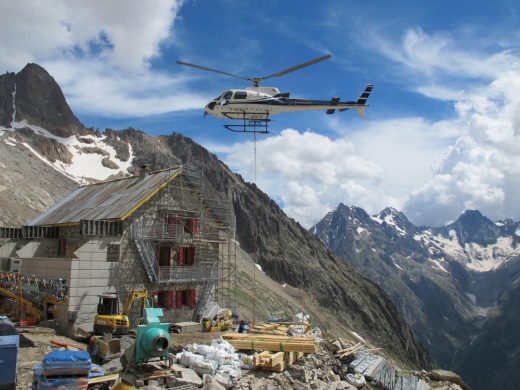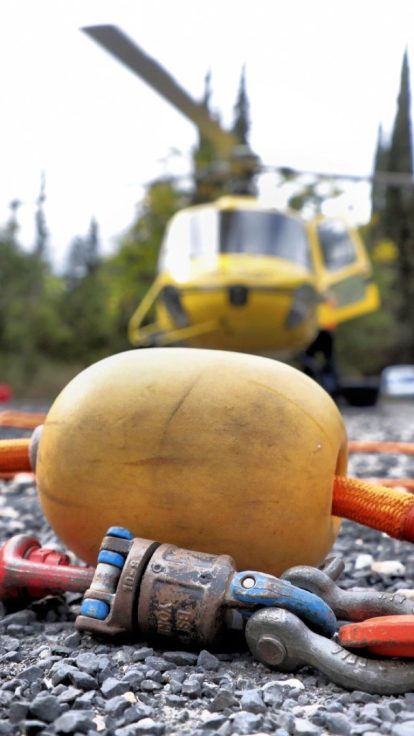
Helicopter sling load operations involve depositing a load by sling to a point that no ground vehicle can reach. Haute-Garonne presents this challenge in two opposing forms, separated by one hundred and fifty kilometers. Helicat Pyrénées has a base there, in Marignac, in the Luchon valley.
To the north, a metropolitan area where ground space is scarce. To the south, high mountains where the road ends. Between the two, an agricultural and industrial plain.
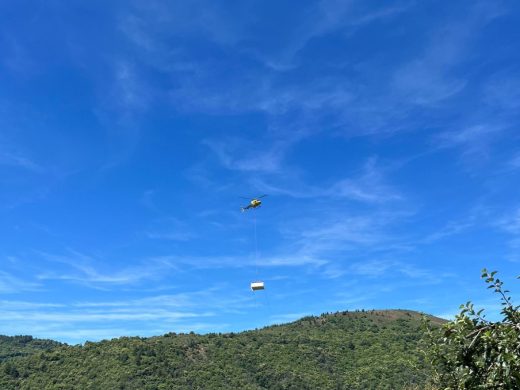
A Long Department, Three Realities
Haute-Garonne stretches for nearly two hundred kilometers, from the Lauragais plain to the Spanish border.
To the north, the Toulouse conurbation concentrates industry, aeronautics, logistics, and a dense historic center. Construction sites there are urban or industrial: roofs, technical elements at height, structures on operational sites.
In the center, the Garonne valley and the Comminges region, with business parks, hydraulic structures, networks, and scattered buildings.
To the south, the Luchon region and the Pyrenean valleys, where high mountain challenges are found: refuges, summer pastures, ski lifts, and high-altitude structures.
A service provider who treats this department with a single method will be mistaken for two-thirds of its territory.
Our Base is in the South of the Department
Our operations depart from Perpignan-Rivesaltes airport, La Llagonne altiport, and the Luchon valley base in Marignac, in the south of Haute-Garonne.
For the Comminges and Luchon regions, this base is the shortest starting point, which is doubly important in the mountains: reduced transit time allows seizing a weather window that opens for a few hours.
For the Toulouse conurbation, the distance is greater. The advantage is no longer proximity but capability: aircraft adapted to the load, preparation of authorization files for dense urban areas, and an experienced ground team for this type of operation.
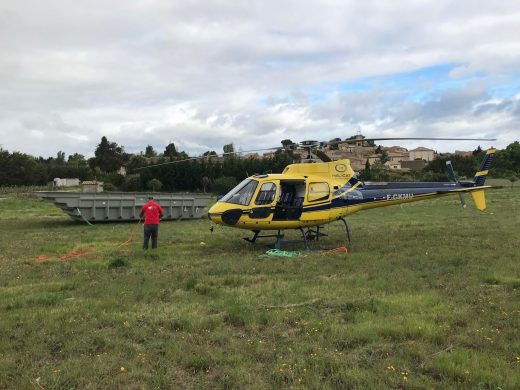
What Projects Require Aerial Lifting in the Department
In Urban and Industrial Areas
Building roofs and terraces, technical elements to be installed at height, structures and materials to be transported to a confined block, interventions on operational production sites where ground lifting is not feasible.
In the Plain and the Comminges Region
Isolated agricultural and industrial buildings, pylons and relay antennas, hydraulic and riverbank structures along the Garonne.
In the Mountains
Resupply of refuges and summer pasture huts, ski lift pylons, footbridges and trails, rockfall protection work on valley roads.
What Remains Constant Throughout
Regardless of the terrain, three things remain unchanged.
The weight determines the aircraft. The AS350 Écureuil covers the majority of projects. Beyond 1,200 kg, and up to 4,500 kg, the load is handled by the H225.
The authorization file is prepared for you: DGAC and prefecture procedures, informing residents when the overflight zone justifies it, coordination with the operator, site manager, or municipality.
And the operation unfolds in four stages:
1
On-site Reconnaissance
2
Permits
3
Slinging with Ground Crew and Radio Coordination
4
Weather Window Confirmed the Day Before
With free rescheduling if conditions do not allow for safe flight.
Our flights are operated under specialized operating certificate FR.DEC.0204, which covers aerial work.
See also helicopter sling load operations in Toulouse, helicopter sling load operations in Bagnères-de-Luchon, helicopter sling load operations in Ariège and our helicopter sling load operations page.
Frequently Asked Questions about Helicopter Sling Load Operations in Haute-Garonne
Do you operate in Toulouse as well as in the Luchon region?
Yes, but the projects and preparation differ. In the city, the difficulty lies in ground footprint and urban overflight authorizations. In the mountains, it’s access, altitude, and the weather window. Reconnaissance and documentation differ accordingly.
Can a load be placed on the roof of an operational industrial site?
Yes, with a ground safety perimeter and coordination with the site manager. The time slot is generally chosen outside production hours or during a planned shutdown, which requires several weeks of preparation.
How much can you lift at altitude?
Less than on the plain. Air thins with altitude and expands with heat, which reduces lift and thus payload capacity. For a mountain project, the altitude of the drop-off point is requested in the same way as the weight.
Can several sites be grouped together on one day?
Yes, if they are accessible from the same loading zone. This is the main cost lever for dispersed assets. However, two valleys separated by a pass are not easily grouped.
What information is needed to obtain a quote?
The weight and dimensions of each load, the number of pieces, the municipality and precise location of the drop-off point, its altitude if in the mountains, a loading zone if you have identified one, and the deadline. You will receive our response within 48 hours.