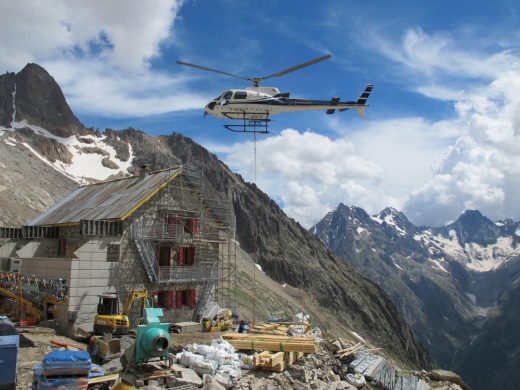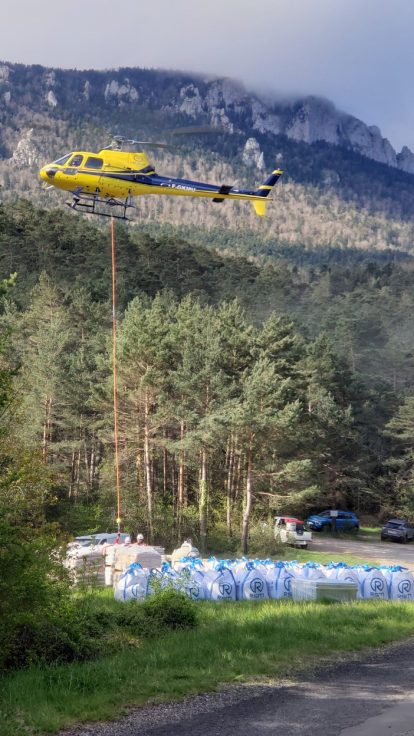
Helicopter lifting places a slung load at a point no ground-based machine can reach. Hérault brings together, over a short distance, two contrasting terrains: a flat, low-bearing coastline, and an inland area that rises quickly. Helicat Pyrénées operates on these sites for professionals and local authorities.
A department that changes abruptly
The wine-growing plain occupies the southern third, between Montpellier, Béziers and the sea, with a chain of lagoons and lidos along the coast.
Then the terrain rises without transition: the garrigue and Pic Saint-Loup north of Montpellier; the Hérault gorges and the Cirque de Navacelles; the Espinouse and Caroux mountains to the west; and the first foothills of the Larzac to the north.
This contrast explains the variety of worksites. Down below, the issue is ground bearing capacity and footprint. Up above, it is access and slope.
Which worksites go by air in Hérault
In the gorges and on the limestone plateaus: cliff stabilization works, nets, anchors, rockfall barriers, with drilling equipment to be placed at the top of the cliff. Hiking facilities, footbridges, structures at the Grand Site de Navacelles.
On the Espinouse and Caroux: pylons, ridge relays and antennas, forestry structures, facilities for the Haut-Languedoc Regional Natural Park.
In terraced vineyards: narrow access, dry-stone walls, steep slopes, where machinery damages the soil and terraces.
On the coast and around the lagoons: hydraulic structures, dikes, developments in protected areas where vehicle traffic is regulated and the ground has low bearing capacity.
And in towns and business areas: roofs, technical terraces, structures on operational sites.
Two constraints specific to the department
First, the risk of forest fires. The garrigue, the Espinouse and the limestone plateaus are among the exposed massifs of Languedoc. During periods of high risk, access to the massifs is regulated and certain works are suspended. The workable season therefore narrows to spring and autumn, and the current prefectural order is one of the points to check, just like the weather.
Second, the Cévennes storm episode, which cannot be worked around and closes the window. The flight is confirmed the day before based on the forecast, with rescheduling at no charge if conditions do not allow safe flying.
Capability rather than proximity
Our bases are in the Pyrenees, at Perpignan–Rivesaltes, La Llagonne and Marignac / the Luchon valley. Hérault is not on our doorstep, and we prefer to say so.
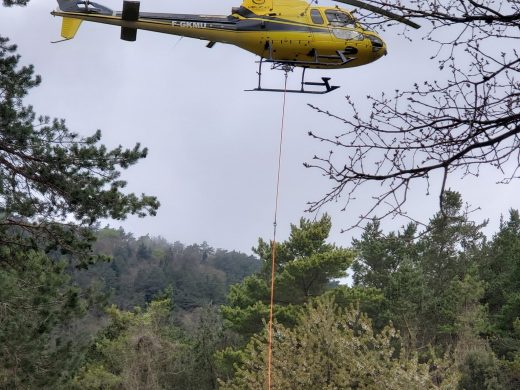
What we bring here is capability: the aircraft suited to the load—AS350 Écureuil from 0 to 1,200 kg and H225 up to 4,500 kg—full preparation of the authorization file, an experienced ground team, and a single point of contact from the first discussion to the final rotation. Depending on the type of worksite, we mobilize the best-positioned partner.
Our flights are operated under the specialized operations certificate FR.DEC.0204, which covers aerial work.
See also helicopter lifting in Montpellier, helicopter lifting in Aude, helicopter lifting in Gard and our helicopter lifting page.
Frequently asked questions about helicopter lifting in Hérault
Can work be carried out in the garrigue in summer?
It depends on the current wildfire risk level. During high-risk periods, access to the massifs is restricted and certain works are suspended. This is a regulatory constraint to be checked when scheduling the operation. Spring and autumn offer safer windows.
How can equipment be placed at the top of a cliff in the gorges?
The load is set down on the plateau, as close as possible to the work area, and the rope access technicians take over from there. Wind channelled by the cliff faces and the approach path must be checked on site; a map is not enough.
Can you operate in terraced vineyards?
Yes, and this is a case where the helicopter avoids damaging the terraces and dry-stone walls. The operation is scheduled with the grower according to the vine cycle and treatments.
Do you operate in protected lagoon areas?
Yes. The ground has low bearing capacity and vehicle traffic is regulated, which often makes helicopter lifting essential. Overflight and set-down are subject to rules specific to these areas, depending on the zone and the period.
What information is required to obtain a quote?
The weight and dimensions of each load, the number of items, the municipality and the precise location of the set-down point, the site’s status if it is protected, a loading area if you have identified one, and the deadline. You will receive our reply within 48 hours.