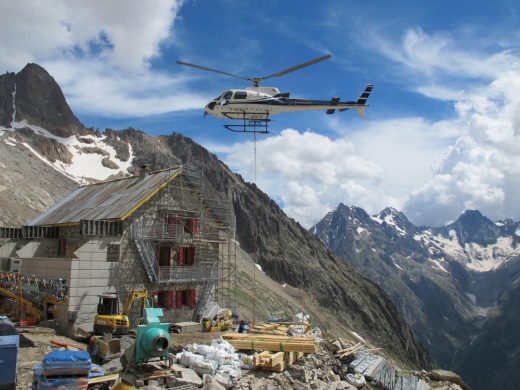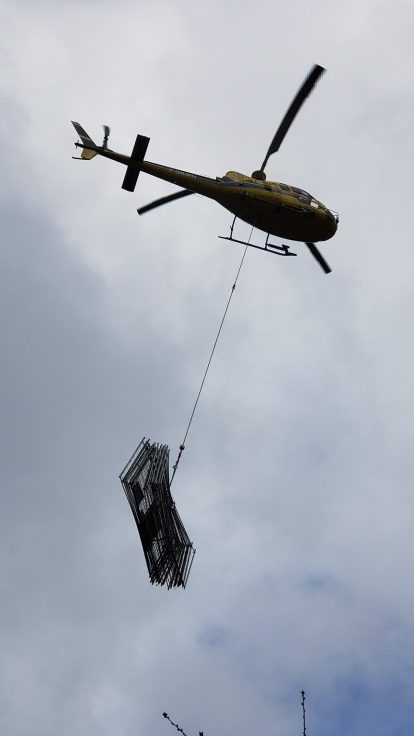
Helicopter lifting involves depositing an underslung load by helicopter to locations difficult for lifting equipment to access. In a metropolis like Toulouse, the constraint is almost never weight. It’s ground space and downtime. Helicat Pyrénées operates on these sites for professionals and communities.
A crane requires space, assembly, disassembly, and often occupies a roadway for several days. A helicopter works vertically and clears the area in just a few rotations.
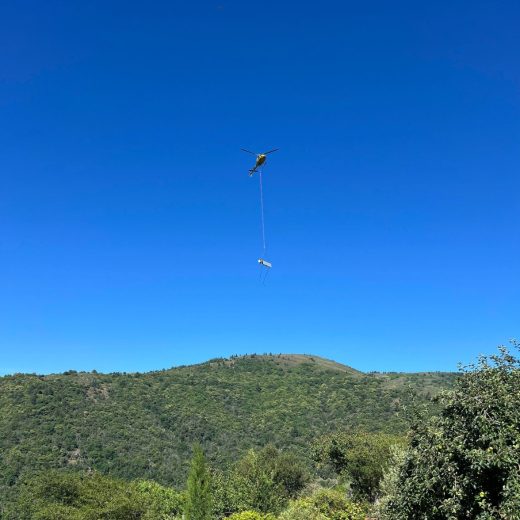
A Metropolis Where the Ground is Already Occupied
Toulouse city center is a dense brick fabric, with narrow streets, largely pedestrian or with restricted access, featuring enclosed courtyards and adjoining buildings. A significant portion of the area falls under protection perimeters that regulate interventions and overflights.
Around the city, the agglomeration concentrates active industrial, logistics, and aeronautical sites where lifting is common, but some points remain out of reach for ground-based means: rooftops, technical terraces, installations in the middle of a production site.
The Garonne river cuts through the city, with banks, quays, and structures difficult to access from the upper roadways.
Which Projects Go by Air in Toulouse
Building Rooftops and Terraces
With technical elements to be installed at height on buildings without rear access.
Industrial and Logistics Sites
Where intervention occurs during a planned shutdown or off-production, on warehouse roofs or operational installations.
The Old Buildings of the Center
Where frameworks, roofing, and restoration elements are difficult to bring in via the street, and scaffolding alone does not solve the delivery problem.
Riverbank structures and infrastructure along the Garonne, and construction sites where available space does not allow for an additional crane.
What is Prepared Before the Flight
Helicopter lifting in a dense urban environment requires more preparation than an isolated site, and it is this preparation that makes the difference between a clean operation and a risky one.
It requires a ground safety perimeter, coordination with the municipality or site manager, sometimes a temporary road closure, and a time slot chosen outside peak hours.
The loading zone is located away from the dense area, on flat ground, accessible by truck, and clear of power lines. Its selection determines the number and duration of rotations.
In an agglomeration with significant air traffic, the approach trajectory is also an integral part of the file. This point is handled upstream, well in advance.
Capability Rather Than Proximity
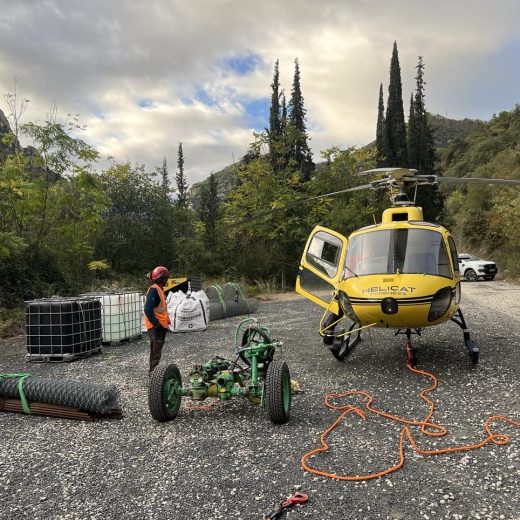
Our bases are in the Pyrenees, in Perpignan-Rivesaltes, La Llagonne, and Marignac / Luchon Valley. Toulouse is not on our doorstep, and we prefer to state that upfront.
What we bring here is not proximity but capability: the right aircraft for the load, complete assembly of the authorization file for dense urban areas, a ground team experienced in slinging in constrained environments, and a single point of contact from the first exchange to the last rotation.
The file is prepared for you: DGAC and prefecture procedures, resident information, coordination with the municipality or operator. The operation then proceeds in four stages: reconnaissance, authorizations, slinging, then weather window confirmed the day before with free rescheduling if conditions do not allow for safe flight.
Our flights are operated under specialized operating certificate FR.DEC.0204, which covers aerial work.
See also helicopter lifting in Haute-Garonne, helicopter lifting in Bagnères-de-Luchon and our helicopter lifting page.
Frequently Asked Questions about Helicopter Lifting in Toulouse
Can helicopter lifting be done over the city center?
Low-altitude overflight above an urban area is subject to specific rules regarding trajectory and height, which take into account local air traffic. This is the first point verified for a Toulouse project, upstream.
Can operations be carried out on an industrial site in production?
Yes, with a ground safety perimeter and coordination with the site manager. The time slot is chosen outside production hours or during a planned shutdown, which is prepared several weeks in advance.
Is it necessary to close a street?
Not systematically; it depends on the drop-off zone and the trajectory. When necessary, the request is made to the municipality and integrated into the file. A well-prepared closure lasts a few hours.
What information is needed to get a quote?
The weight and dimensions of each load, the number of pieces, the address and precise location of the drop-off point, known access constraints, and the deadline. You will receive our response within 48 hours.