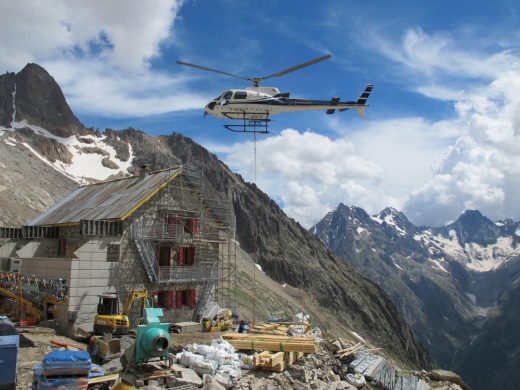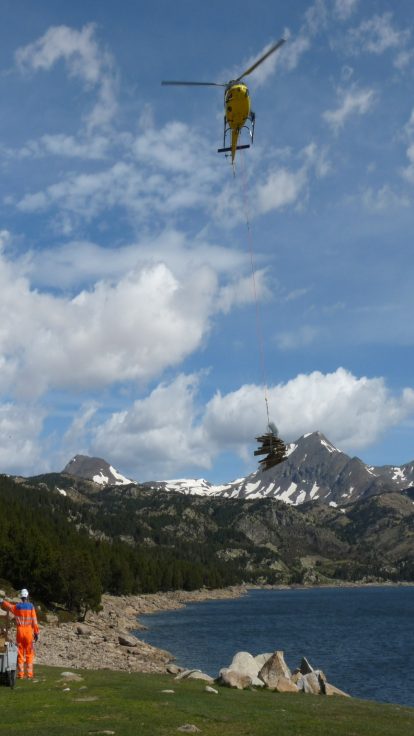
A water-bombing helicopter is an aircraft equipped to collect water and drop it on a forest fire. It differs from water-bombing aircraft in its ability to work low, slowly, and to refuel from a reservoir close to the incident. Helicat Pyrénées is an aerial work operator based in the Pyrénées-Orientales.
The water-bombing helicopter does not replace ground firefighters. It gives them time and intervenes on points that are difficult to access.
The Advantages of Helicopters in Forest Firefighting
The helicopter can intervene as close as possible to the areas requiring treatment. Its maneuverability allows targeted drops on a fire flare-up, an isolated hot spot, or an area difficult to access for ground crews.
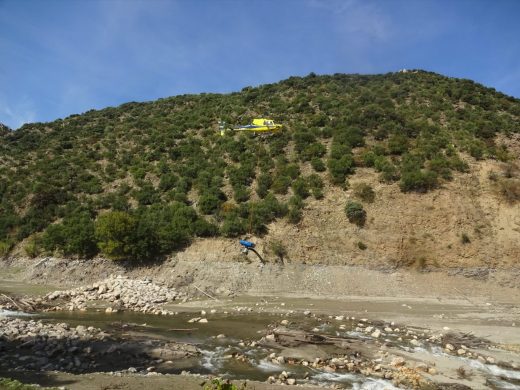
It can also operate in rugged terrain, particularly in narrow valleys and on wooded slopes. The proximity of a suitable water source allows successive rotations and concentrated drops where they are needed.
This targeted intervention capability makes it a valuable asset for supporting crews engaged in forest firefighting.
1
How a Rotation Works
The principle is simple, and its repetition is what makes it effective.
The aircraft collects water from an identified reservoir, either via a belly tank or a flexible bucket on a sling filled in hover. It proceeds to the drop zone, often within a few minutes. It drops on a point designated by the sector chief or aerial coordinator. Then it returns.
The duration of a rotation depends almost entirely on the distance between the reservoir and the fire. This is why identifying usable water sources is a prevention task in its own right.
2
The Role of the Water-Bombing Helicopter
The water-bombing helicopter helps slow the progression of a fire and treat hot spots. Its drops support the action of ground crews, who continue the extinguishing work.
Its intervention depends on conditions on site. Wind can reduce drop precision, while smoke can limit visibility. Night operations require specific equipment and procedures.
When multiple aircraft intervene on the same fire, their actions are coordinated to maintain appropriate separation and ensure the safety of flight crews and ground teams.
3
Who Commands a Water-Bombing Helicopter
In France, forest fire response falls under civil protection and the SDIS. National resources are supplemented, depending on needs and departments, by aircraft chartered from private operators.
Deploying a water-bombing helicopter on a fire goes through the operational emergency response chain. Availability contracts are handled directly with local authorities and relevant services.
Our Other Services
Helicat Pyrénées provides external load operations, aerial surveillance, and LiDAR mapping from its bases in Perpignan-Rivesaltes, La Llagonne, and Marignac/Luchon Valley, and throughout France through its partner network.
Our flights are operated under specialized operating certificate FR.DEC.0204, which covers aerial work.
For lifting or inspection needs, see external load operations, aerial surveillance, and LiDAR survey.
Frequently Asked Questions About Water-Bombing Helicopters
How much water does a water-bombing helicopter carry?
It depends on the aircraft and its configuration: 800 to 1,000 liters for the AS350 depending on the bucket or tank used, and up to 4,000 liters for the H225. Altitude and temperature reduce payload capacity, so the same aircraft carries less in high heat—precisely during forest fire season.
Why use a helicopter rather than an aircraft?
For precision and for terrain. The helicopter flies slowly and low, drops on a precise point, and refuels from a nearby reservoir. Aircraft cover more frontage but need space. On a fire in a valley or on a wooded slope, the helicopter goes where aircraft cannot descend.
What does a drop actually accomplish?
It lowers the temperature and slows propagation on a section of the fire front, which opens a window for ground crews to advance. Extinguishing itself is done on the ground: the water-bombing helicopter is a support asset.
Where does the helicopter refuel with water?
From any reservoir that is sufficiently deep and clear: dam lake, hillside reservoir, watercourse, cistern, and sometimes swimming pool. Prior identification of usable water sources is a prevention task in its own right.
Can one request a water-bombing helicopter?
Deployment of aerial resources on a forest fire goes through the operational emergency response chain: firefighting falls under civil protection and the SDIS. Availability contracts are handled directly with local authorities and relevant services.