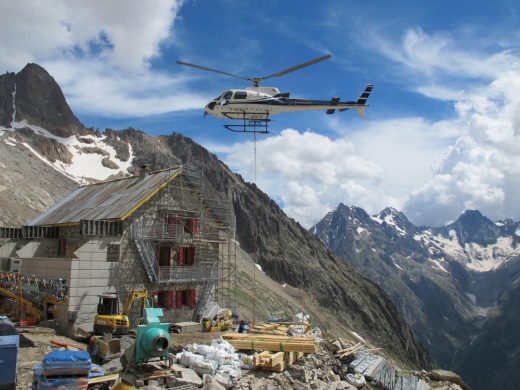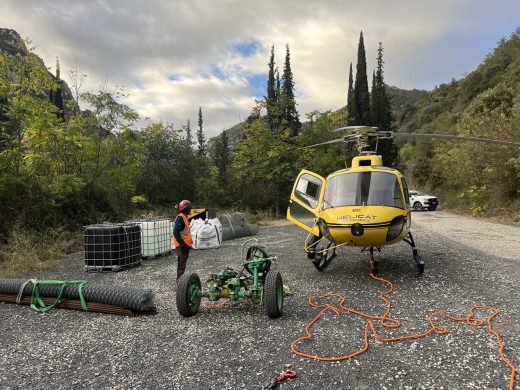
On a helilifting site, safety is determined before takeoff. Four points decide everything: the choice of landing zone, the quality of slinging, the identification of aerial obstacles, and radio coordination between the ground crew and the pilot. An error on any of these four points cannot be corrected in flight.
This is why a serious operator never works from plans alone. Site reconnaissance is conducted on location, and it determines everything else.
Reconnaissance: The First Piece of the File
Reconnaissance establishes the flight scenario. The loading zone and drop-off point are selected, the distance between them is measured, obstacles are identified, fallback zones are designated, and roles are defined for the day of operation.
Three elements are decided here and cannot be decided elsewhere: the actual altitude of the drop-off point, which determines the aircraft’s useful load; the nature of the loading zone surface, which must be flat and load-bearing; and the approach trajectory, which is dictated far more by terrain and channeled wind than any map would suggest.
The Landing Zone and Loading Zone
A usable loading zone is flat, load-bearing, clear, and sufficiently distant from third parties. It must accommodate the delivery truck, slinging equipment, and the crew, without anyone having to pass beneath the load.
On the drop-off side, the constraint changes: the surface is often reduced, sloped, sometimes on scaffolding or a roof. The drop-off point is marked on the ground before the flight, and a single person designates it to the pilot. Multiple contacts at a landing zone is the primary cause of confusion.
- Marked and maintained safety perimeter, including on the public side
- No unsecured lightweight items in the rotor wash: tarps, panels, cones, insulation
- Fallback zone identified for the ground crew
- No one remains or moves beneath the load trajectory
Slinging: What Breaks, and Why
Slings and lifting accessories are sized for the actual load, with a safety factor. What causes problems in the field is almost never the nominal strength of the equipment, but three other factors.
Balance first: an improperly centered load oscillates, and an oscillating load becomes unpilotable. Wind resistance next: a panel, tarp, or mesh behaves very differently from a compact mass of the same weight. Slinging angle finally, which sharply increases tension in the strands as it widens.
Lifting equipment is inspected before each site, and accessories are tracked. A load whose mass is stated as “approximately” is a load that is not lifted: it is weighed or estimated from its dimensions and material.
Aerial Obstacles
Power lines, cable car cables, guy wires, antennas, isolated trees. A cable is difficult to see from the cockpit, and it is the most serious risk of low-altitude flight.
They are identified during reconnaissance, recorded on the flight plan, and physically marked when possible. If your site includes a line, even if out of service, it must be reported from the first exchange. This also applies to neighboring work: a crane erected the week following reconnaissance changes the scenario.
Ground Coordination and Radio
On the day of operation, the ground crew and pilot are in constant radio contact. Roles are assigned before the first takeoff: a loading zone supervisor, a drop-off point supervisor, an operations manager who arbitrates.
The rule that supersedes all others: anyone can interrupt the operation, no one can force it. A doubt about a sling, a person entering the perimeter, rising wind, and the rotation stops.
The Weather Window, and the Right Not to Fly
Wind and visibility decide. A helilifting flight is confirmed the day before based on forecasts, and a cancellation for weather reasons remains possible up to 24 hours in advance, with rescheduling at no charge.
Postponing a site is never comfortable. But a postponement can be recovered, an incident cannot. This is the only decision that is non-negotiable, and it belongs to the pilot in command.
Our flights are operated under specialized operating certificate FR.DEC.0204, which covers aerial work. To prepare an operation, describe your project to us in a few words.
Frequently Asked Questions
Who is responsible for safety on a helilifting site?
Flight safety is the responsibility of the pilot in command, who alone decides whether to fly. Ground zone safety is shared between the operator and the client, according to a distribution defined during reconnaissance and reviewed during the day-of-operation briefing.
What safety distance must be maintained around the landing zone?
It depends on the aircraft, the load, and the site configuration, and is established during reconnaissance. The principle is constant: no one moves or remains beneath the load or its trajectory, and the perimeter remains secured throughout the duration of rotations.
What happens if the weather deteriorates on the day of the site operation?
The time slot is confirmed the day before. If conditions do not allow safe flight, the operation is postponed. A cancellation for weather reasons is possible up to 24 hours in advance, with rescheduling at no charge.
Do the client’s ground crews need to be trained?
Formal training is not required, but a briefing is. It covers the perimeter, movement instructions, behavior under rotor wash, and the contact person. Our crews conduct it on site before the first rotation.
Can people be overflown with a load?
No. The trajectory is designed so that no load overflies third parties. This is one of the constraints that shapes the routing of an operation, particularly in urban areas, and it is addressed during file preparation.