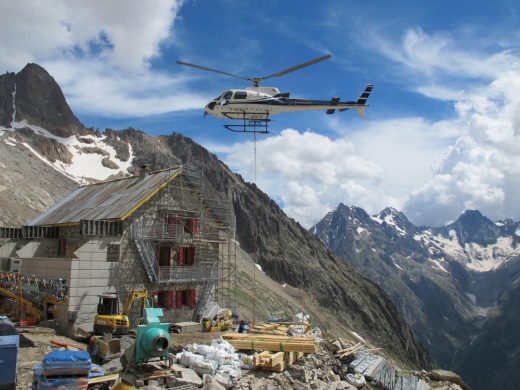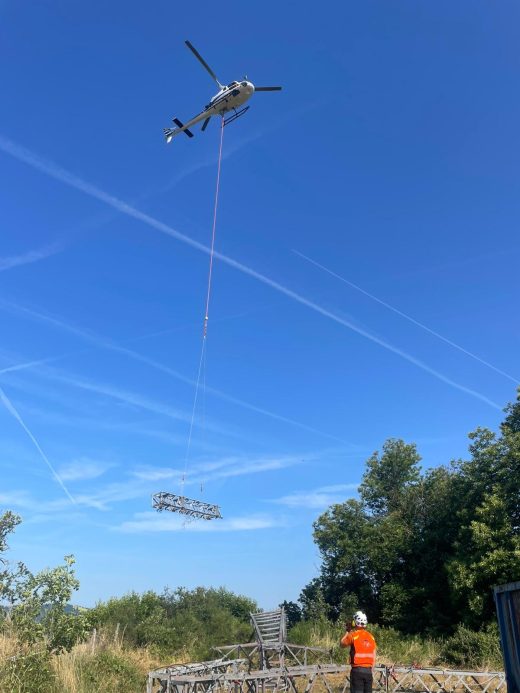
Helicopter transport serves six types of construction sites: power grid maintenance, mountain huts and high-altitude structures, photovoltaic installations, protection against natural hazards, heritage restoration, and urban lifting. The common factor is no longer altitude, but access: as soon as a crane cannot reach the drop-off point, the load is moved by air.
What has changed in recent years can be summarized in one sentence: construction sites are moving to locations that roads do not serve. Network renewals in the mountains, solar parks on plateaus, slope protection above regional roads, and the renovation of listed buildings. In each case, the question is no longer whether the helicopter is useful, but at what point in the schedule it intervenes.
What drives construction sites to the air
Three constraints recur systematically. First, the ground footprint: a crane requires a platform, access roads, assembly, and disassembly. On a steep slope, in a narrow street, or on a protected site, this footprint cannot be cleared without lasting damage to the terrain.
Next, the schedule. Creating an access track takes weeks. A helicopter rotation takes minutes, and a day of flying often replaces several days of land-based logistics.
Finally, reversibility. The helicopter leaves no trace: no tracks to close, no platforms to dismantle, no restoration required. On a listed site or a protected natural area, this is often what makes the project acceptable to the manager.
The six types of construction sites that use it
Power grid maintenance
Pylons, insulators, cable pulling, and equipment removal on lines. Grid managers use helicopters to work on supports located out of reach of machinery and to avoid opening tracks in wooded areas. The flight is often combined with an inspection: see also our aerial surveillance page.
Mountain huts and high-altitude structures
Construction materials, prefabricated modules, tanks, and construction waste removal. A mountain hut is resupplied by successive rotations during a short weather window. This is the historical use of helicopter transport in the mountains, and it remains the most intensive in terms of the number of rotations.
Photovoltaic installations
Modules, support structures, and drilling equipment for anchoring. Solar parks are increasingly installed on sloping terrain or poorly served plateaus, where a constant stream of trucks is not feasible.
Protection against natural hazards
Rockfall barriers, protection nets, and rock face anchoring. By definition, these projects take place on unstable slopes, above a road or a dwelling. The helicopter drops the equipment directly at the assembly point, without ground intervention below the zone.
Heritage restoration
Scaffolding, stone, big bags, and light machinery. A perched castle or a coastal tower has no vehicle access. Our interventions at the Château de Puilaurens or the Vinça dam follow this logic: see our projects.
Urban lifting
Air conditioning units, technical elements on roofs, and structures to be placed in closed blocks. In the city, the helicopter operates vertically and clears the space in a few rotations, whereas a ground installation would block a street for several days. This activity is covered by our specialized operating certificate FR.DEC.0204.
How the load affects the choice of aircraft
The mass to be lifted determines the machine, never the other way around. Our intervention range goes from 0 to 4,500 kg under-slung, with two aircraft:
- AS350 Écureuil, from 0 to 1,200 kg — the basic aircraft, versatile and maneuverable. It covers the majority of sites: concrete, big bags, beams, steel girders, tubes, photovoltaic modules, and drilling equipment.
- H225, from 1,200 to 4,500 kg — it takes over for large components: hydraulic turbines, masts, structural elements for mountain huts, bridges, and dikes.
Altitude and the day’s temperature reduce the payload. The same aircraft carries less in high heat or at a high drop-off point, which is calculated during the site survey and not on the day of the flight. The details of this logic can be found on our helicopter transport page.
Where We Operate
Helicat Pyrénées is located in the south of France, with three bases: Perpignan-Rivesaltes airport, La Llagonne altiport, and the Marignac / Luchon valley base. We operate throughout France thanks to our network of partners. Describe your project to us in a few words, and you will receive our response within 48 hours.
Frequently Asked Questions
How much weight can a helicopter lift under-slung?
This depends on the aircraft, the altitude of the drop-off point, and the day’s temperature. Our range goes from 0 to 4,500 kg: the AS350 handles loads up to 1,200 kg, and the H225 takes over beyond that. If you do not know the exact mass, the dimensions and material are sufficient to estimate it.
How long does a helicopter transport operation take?
The flight itself is often measured in hours, sometimes in minutes per rotation. What takes time is the preparation: site survey, assembly of the authorization file, and coordination with the manager or the municipality. A project is generally scheduled several weeks in advance.
Is helicopter transport possible in listed sites or protected areas?
Yes, and it is often the only practicable option, precisely because it leaves no trace on the ground. Site-specific authorizations are added to the usual file and are processed prior to the start of the project.
Can helicopter lifting be performed over urban areas?
Yes. Aerial work in urban areas is subject to specific rules regarding trajectory, height, and the safety perimeter. Our flights are operated under the specialized operating certificate FR.DEC.0204, which covers aerial work and helicopter transport in urban areas.
Do you operate throughout France?
Yes. Our three bases are in the Pyrénées-Orientales and Haute-Garonne, and we cover the rest of the country with our network of partners. In both cases, you keep the same point of contact, from the site survey to the final rotation.